Showing posts with label Woody Allen. Show all posts

Tuesday, July 19, 2011

Forgotten Characters 4.2

Ensemble films tend to turn up when you get to thinking about forgotten characters. With casts that are as expansive as most large ensembles there is some actor who ends up getting shafted – especially when their role isn’t as pivotal to the story’s major arcs. Thus, in a way, I can understand why this particular performance isn’t remembered more often but I still have massive love for

Patricia Clarkson in Vicky Cristina Barcelona
as Judy

Judy is something of an emissary in Vicky Cristina Barcelona. It’s her house that Vicky and Cristina stay at whilst in Barcelona; it’s through her – tangentially – that they meet Juan Antonio and so on. Vicky Cristina Barcelona isn’t quite classic Woody so there’s a tendency for Judy’s appearances in the film to feel a bit perfunctory at times but that’s where Patricia Clarkson comes in. She’s more than adept at acting from the side-lines and infuses Judy with some interesting tics to make her more than just a springboard for the film’s bigger issues. One of her first lines in the film is her throwaway, “It’s so nice to have a little action around here” to the girls. It sounds a bit on-the-nose considering the hijinks they’ll get in to later but I like to think of it as proof of how much of an instigator Judy likes to be. She wants the girls to get into shenanigans so she can live vicariously through them, but as early as her first scenes you get the feeling that she’s jealous of their youth. When Vicky talks of her academic future and her fiancé, Judy glibly responds,
“All her conflicts will be resolved when he makes her pregnant.”

It’s not even said bitterly, that’s just what Judy thinks of married woman – no identity.

It’s a lead up, of course, to her big scene in the beginning of the film’s third act, after Vicky witnesses her kiss with her husband’s friend Jay.
“I haven’t been in love with Mark for years.”

It’s not the most seminal of monologues, she goes through the usual concepts of an unhappy marriage, a fear of getting out of it, the moment passing but it’s not so much the lines as Patty’s expressions through out.
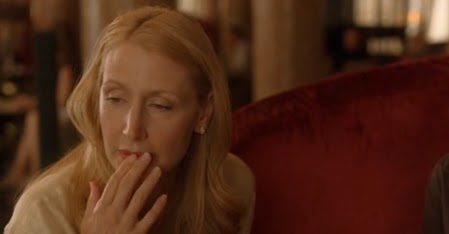


 And that line, “I can’t leave him now, and I know I never will.”

Our final shot of Judy occurs after her misguided attempts to get Vicky to hook up with Juan Antonio. With her plans awry she settles, desolately, back into her routine – no excitement to vicariously enjoy. If that isn’t the face of a woman with a backstory, I don’t know what is.
 
Perhaps it’s not Woody’s Judy which is memorable…it’s Patricia’s interpretation of it.
      
Do you have any left over love for Patty in Vicky Cristina Barcelona, or is she lost in the shuffle?

Friday, June 3, 2011

Encore’s Birthday Marathon: Day 17

I’ve got something of an aversion to physical comedy. Even as a child I couldn’t stand cartoons like Tom and Jerry which made their “humorous” point without the use of dialogue. In Iris Kate Winslet has this quote, “Without words, how can one think?” and although I get the sense that cinema is a visual medium I need words in my life. So, it makes sense that when I think of the comedy I’m most drawn to, it centres on wordplay. Enter Woody Allen...

                  
As much as I love Woody, I can watch each of his films and understand why his humour won’t work on everyone. I love it, nonetheless. It’s probably a bit marginalising of me to call him a comedic writer/director but even in his most serious of films he retains that imprudent humour that makes for a wholly irreverent cinematic experience. It’s alleged that Katharine Hepburn was not a fan of him, but I always like to think of what the two would have been like to have one her zany characters in a Woody piece. Imagine Alice Adams lost in Manhattan or Susan Vance squaring off with Annie Hall. Hilarity would ensue, I tell you.
            
I’m a staunch Woody supporter, even if he doesn’t appear as the best comedy on my list of favourites. I’m still wary as to whether or not Gosford Park qualifies as a comedy. It encompasses such a wide gamut of cinematic genres that i can’t call it an exclusive drama, mystery, comedy of manners, ensemble piece or anything really. It just is (brilliant). The Graduate and The Apartment are the next two comedies, and I love Nichols but I rarely think of him in comedy terms and as good as Billy Wilder is I’m not an especially big fan of his. There just seems to be something vaguely kitschy about his work, which isn’t necessarily bad it just doesn’t always work for me (even though I think The Apartment is priceless.)
       
Humour is a funny thing, though (funny, weird). I wouldn’t say that it’s more difficult than drama, but it’s much more subjective. Me, I laugh harder when there’s a darker undertone looming. It’s like that episode of Pushing Daisies when the candy store opens opposite and the guy says that candy tastes that much sweeter with a taste of the bitter. That’s comedy for me.
        
Who are your comedic giants?

Wednesday, May 25, 2011

Encore’s Birthday Marathon: Day 8

            
Whenever I’m asked which city I’d most like to inhabit I always say Paris. It’s just because I have a sort of obsessive attraction to everything French, even though my knowledge of the language remains sparse after years of school French (I’d probably be a fish out of water, a la Dave Sedaris in “Me Talk Pretty One Day”. As far as being a lover of all things artistic (heh) goes, though, I’d probably choose New York in a heartbeat. Jose was only recently fêting it (well, the Met actually), and with good reason.
 
As far as cinema goes Woody Allen seems to have the monopoly on the city. It probably makes sense because he exudes that sense of zany neuroses that people tend to think of the city with. Still, it’s not Woody who I turn to when I hear the name of the city – I turn to Liza, with Z, first. It’s not just because I’m a lover of Scorsese, I really do think that New York, New York is one of the best films of the seventies (and one of the best films to not receive an Oscar nomination). It has its moments of less than perfect scenes, but it’s an ultimately rewarding experience. For me, its themes effectively evoke that gritty realness tied with the sort of magical sheen that best encapsulates the city – larger than life, really. Plus, the film’s most iconic scene – as far as I’m concerned – is about a budding Broadway showgirl. And what else is as indicative of New York as The Great White Way 
                                                           
It’s not just cinema, though. New York is as much a location as it is a character in two of the greatest comedies of the nineties (and all time, probably) Friends and Sex and the City. Sex and the City in particular depends on that attractive but sometimes exasperating hubbub of the city (which is probably why the excursions away from it tend to fall flat). In truth, I can’t say I’d be interested in seeing New York for the tourists’ attractions. It’s like that Friends episode where Joey didn’t even know that the Met was a museum and not the singular of the Mets – the baseball team. If I do end up in New York I’d probably divide my time between the cinema and the theatre, or maybe I’d make time to do a Jane Fonda and go barefoot in the park.
                 
I don’t know. It’s a sort of perfect tourist’s paradise. I’m not a tourist at heart, but I still want to go.
 
Any New Yorkers reading?

Saturday, October 2, 2010

The Spin-Off, Season One: Episode 4

Other than Cairo Time when was the last time Patricia Clarkson was front and centre in a film? She’s been constantly popping up in movies, with some significant parts here and there but rarely have I seen her anchor a film – and it’s not for a lack of talent. I remember watching Vicky Cristina Barcelona and being strangely interested in Patricia’s bored wife. Depending on you speak to Woody’s Vicky Cristina Barcelona is either horribly bland, placid and different or just horrible. I’d say everyone does a good job, it was some time before I became a complete believer in Penelope’s Marie Elena but I was immediately struck by Patty’s Judy. She seems to be explicitly exist as a character from some other Allen film (Husbands & Wives).
 
One thing Woody has always been able to do is convince you that his supporting characters are leading players in their own worlds and I could only imagine what the life of Judy must be. Patricia brings such a ridiculous self-absorption to the role that’s sometimes easy to miss. But, more importantly she plays Judy as a desperate housewife but not a pathetic. I’ll probably be a believer in Woody’s talent for life even if he doesn’t all get the ace in the hole. Only recently Burning Reels suggested that Woody turn to his former heroines (Dianne, Diane, Mia) to make a film about the older girls, but I think a prequel on Judy’s apparently tedious marriage could be just as interesting. I probably was one of the few that liked Whatever Works, and Patricia was smashing in it. I’d like to see her tackle Woody again.
         
What about you? Would you be interested in seeing Patty holding down a Woody film?
        
Previously:

Tuesday, August 3, 2010

Movie Meme, Day 4: A Movie That Always Makes Me Laugh

I know it would sound weird to most, but the movie that always makes me laugh isn’t my favourite comedy. I’ll eventually feature my favourite comedy when I reach it on my list of favourite films but when I think of a film that always makes me laugh – sometimes ridiculously I must return to America’s consummate comedian (writing-wise) – Woody Allen.

It’s ironic that the Woody film I find funniest (NOTE: it’s not my favourite film of his) is the one that he writes with the help of an ally. Bullets Over Broadway is a film that’s so brilliant I’m always a little irked that it’s not remembered more. John Cusack takes over the role as the bathetic hero (a stand-in for Woody). “I’m an artist” – those are the first words from his mouth, of the film actually. And the story is a hilarious comedy of errors wherein Cusack’s David comes to question his artistic worth. One of the things that makes Bullets Over Broadway so brilliant is the fact that it has a serious and honest message underneath – one that hits home even as you’re laughing tears through the antics of the characters.
I highlighted it months ago as one of the best ensembles of the nineties – and it is. Cusack has always been woefully ignored, and though he’s had the usual missteps he’s given a number of good performances. Chazz Palminteri tries his utmost to the steal the show and Jack Warden, Jim Broadbent and Bob Reiner offer timely comedic support. But like so many of Woody’s pieces it’s all about the women. Mary Louise Parker does a lot with a role that doesn’t seem as much, Tracy Ulman elicits a laugh (or at least a wan smile) with each appearance on screen, Jennifer Tilly channels her inner Jean Hagen taking the concept the concept of dumb to a whole other level. But it is Dianne Wiest in her splendid diva-esque glory that hijacks the film and educes the heartiest laughs. Blink and you’ll miss the fact that she has the broadest of characters, a character type really, the film is all about the vignettes’ but Woody knows to kill us with the one-liners and the cast knows to kill us with the deliveries.
           
I reviewed Bullets Over Broadway some time back, and I stand by my belief that it’s the best film 1994 had to Oscar…if this doesn’t make you goofy with laughter…well, I’ll not finish that sentence. Just see it, because You stand on the brink of greatness. The world will open to you like an oyster. No, no, not like an oyster. The world will open to you like a magnificent vagina. That's a direct quote.


And I'm still MEME-ing....

Thursday, June 24, 2010

Flashback: Match Point

Woody Allen is a bit of anomaly himself. His work is always tinged with what seems like wild abandon while still retaining that obvious smidgen of self conscious that makes you aware that he’s very aware that you’re aware of all the little tics he’s giving his characters (in terms of dialogue). His attempts at being self-effacing work as much as they don’t and it’s probably why he’s most “suited” for comedy (though I’ve still to see a number of his important dramas). Match Point is every bit like that, and the fact that it’s protagonist and de facto female lead are consciously and deliberately using their words to trap us only make the film seem a little smug, but I like smug. Early on Chris asks Nola Rice, “What did I walk into?” After a sudden turn of events she replies almost immediately, “What did I into?” By this time, the audience is probably wondering the same thing and it’s too Woody’s credit (but not his alone) that we leave the film still uncertain of what we’ve just taken part in.
Match Point is not a rags-to-riches tale, though such a description could suffice for a time. Chris is a personable and ambitious young man who temps as a tennis trainer; he meets an affable rich girl and strikes up a romance and steadily climbs in her father’s company as he overcomes the troubles in their marriage. The end? Yes, but not the whole story. Nola Rice is a struggling actress and the girlfriend of Chris’ brother-in-law. She’s temperamental and American and nothing suitable for this British upper-class family. Like Chris she’s an outsider, unlike Chris she’s not that good of an actor. Unsurprisingly, they’re drawn to each other and their relationship turns Match Point into many things – a melodrama (perhaps), a fantasy (likely), a tragedy (to a point), a thriller (always), a whodunit drama (maybe, maybe not). But Match Point isn’t interested in being part of a genre. It is similarly like and unlike anything we’d usually see in the cinemas. It was moderately successful upon its release and months later its brilliance had waned (according to the public at least). It went from a potential Oscar dark horse, to a nominee for its screenplay – nothing more. Yet I’d list Match Point easily among the decade’s best. Woody’s writing is a staple; I sincerely believe there’s nothing that he cannot do. His writing is so good we tend to forget how adept he is at bringing out the best in his actors (see Wiest, Farrow, Tilly, Keaton), and if the house of Match Point is built on Woody’s words then the acting is everything else.
I have been a fan of Scarlett Johansson for a long time, before it was the cool thing and after it was the cool thing. I still consider her to be one of the best actresses in her age bracket. Her problem, like so many is realising her strengths. She is more resourceful than we realise (just look at the three performances Woody has led her to) but Nola Rice is the perfect creation for her. It’s the sort of woman we don’t know when to trust (if at all) and Johansson’s natural cadence works well even in moments where Woody almost falters (e.g. that coffee shop confession piece plays like a gem despite it’s script issues). What do I know? Maybe she is playing herself? But what the hell do I care when she’s playing it so excellently? She doesn’t have the shouting voice so Woody’s words let her get all those soft line readings in just beautifully. I wonder if erred on Wednesday in leaving her pairing with Jonathan Rhys Myers off the list of beautiful screen couples. When Woody has Chris say “Has anyone told you you have very sensual lips?” I can’t help rolling my eyes. Just look at them, for god’s sake. Ugh, they’re gorgeousness makes me sick.
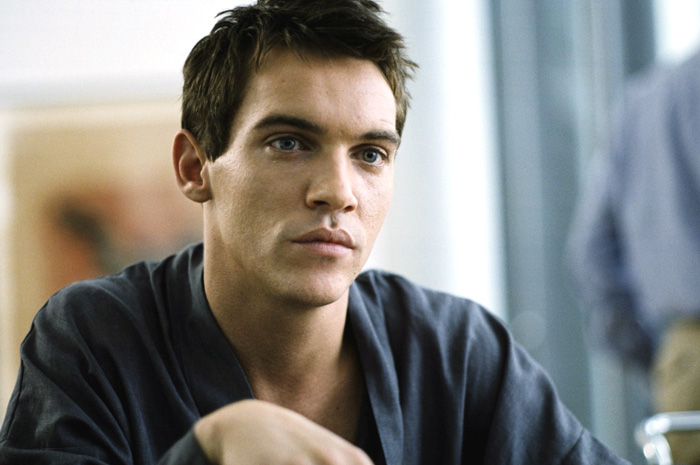
Looking in from the outside Match Point’s payoff shouldn’t work, but I’d be the first to tell you that it does – excellently. Jonathan Rhys Myers is talented (even though I forget sometimes) he’s doing excellent work on The Tudors and with the exception of maybe Woody himself (and perhaps John Cusack) he’s my favourite Woody leading man. It’s not a popular choice, but each of Rhys Myers strange acting idiosyncrasies (his penetrating stare is a bit scary at times) works perfectly for Chris. The supporting cast don’t stand out as much as most Woody films, but Brian Cox and Emily Mortimer particularly are delights to watch, well as delightful as one can be in such a dryly humorous tale. Anyone who says Woody's heyday finished in the nineties is clearly not paying attention.
         
How was Match Point and its lead performances held up for you? Do you share my love?

Saturday, June 5, 2010

Three Women…Three Years…Three Paragraphs

What is about the number three that makes it so…special?
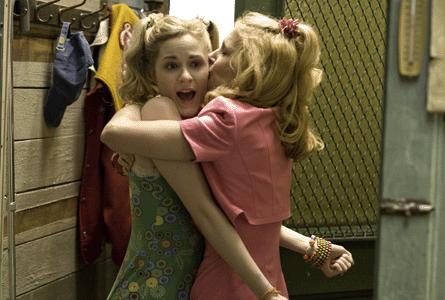
I was surprised, but gratified when in the comments’ section of my review of Annie Hall love was professed for Allen’s Hannah and Her Sisters. If the 1977 classic is more then the (relative) serenity of Hannah and Her Sisters must certainly be less. But as the saying goes, less is more, and with Hannah and Her Sisters it’s true. Yet, in theory at least, Hannah and Her Sisters shouldn’t be so excellent. Its irrepressible good-natured manner in the face of disaster is a bit alarming – even for Woody. But when I think of Woody’s greatest, I return to this comedy because Woody has always done best when he takes a group of neurotic and sometimes perverse characters and turn their tales into something deliciously wonderful. Having the opportunity to visit these characters over three years gives him the ideal chance to examine all the things he loves – relationships, religion, family, careers – and he does so with aplomb.
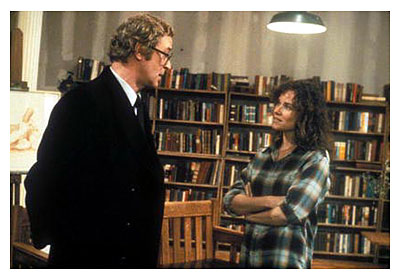
Dianne Wiest, Carrie Fisher, Michael Caine, Max Von Sydow Mia Farrow  Barbara Hershey and Woody himself. The man knows to work well with his cast members, thus Hannah and Her Sisters has that extra special something that makes it an almost peerless ensemble. Naturally Woody’s not for all, heaven knows why, but he isn’t. Still, when he’s on his game he’s supreme and every actor in the film is having a good time reading off lines from his Oscar winning script. When I made my list of memorable sisters on screen Hannah and Her Sisters missed by inch, but the relationship between Hershey Wiest and Farrow is wonderfully true. Sure, it’s not as quirky as the other trio of sisters that year but the focus is more expansive and Woody is careful not to make any one of them the “important” one – even if Hannah’s name is the only on in the title. I’m somewhat amused when I think of its name really, Hannah and Her Sisters seems like a misleading title. It is about the sisters and their work, but I’m unsure if that’s ideal name for it. But then, I suppose it’s an attribute of Woody. Annie Hall isn’t really about Annie Hall alone…is it?
So, yes, Hannah and Her Sisters is my favourite Woody piece. It’s something that many fans would say, and I guess sometimes it pays to agree with the masses. Between this and A Room With a View I’m just slightly miffed that the Oscar went to Platoon - which is actually a good winner. But who cares? Prizes are prizes and yet Hannah and Her Sisters continues as a treasure to the comedic genre. It’s troubling though, even though it’s remembered as one Woody’s best I don’t hear as much about it as I’d hope. Sure, it’s been over twenty years but it’s still worth remembering and falls at #13 on my list of favourite films. I’ll always remember Woody’s manic search for a religious epiphany in the film, a scene that has become a bit too spoofed in recent times…what do you remember first when you think of Hannah & Her Sisters (and their men)?

Wednesday, May 19, 2010

“La de da. La de da. La la.”

One of my favourite scenes in Annie Hall happens some time into the film, although chronologically it’s somewhere near the beginning. Annie drives Alvy to her house after a game of tennis. They seem to like each other, but Alvy’s so antagonistic and Annie is such a ‘dweeb’ they’re uncomfortable. Annie starts telling him about a relative of hers that had narcolepsy. Diane’s Annie is there telling the story in all her affable weirdness, and halfway through you get the distinct sense that Annie doesn’t know where the story is going – or why she started telling it in the first place. It’s a weird moment, but I often think if you’re not a fan of this scene you’re not a fan of Annie Hall. For me, Annie Hall is one of those films that has become so lauded that I often doubt people who claim to “love it to death”. It’s not that I doubt the possibility of anyone else finding it to be good. But Woody Allen, a man who is on his known is known for delighting in the off kilter, crafted with Annie Hall one of the most perversely atypical, deliciously satisfying and irrevocably original romantic comedies. Annie Hall is an anomaly – in more ways than one.
It opens with Allen breaking the fourth wall. It’s one of my favourite conceits of the film, and in a film I love so much that’s saying something. In its way, Annie Hall is akin to private conversations with a neurotic. It’s almost as if retelling his story is a cathartic way for Alvy Singer to deal with his issues – and there are so many of them. Few filmmakers are as comfortable in their idiosyncrasies as Allen. Each director I admire has their secret weapon – Kazan has a knack for sympathising with the disturbed and disturbing, Scorsese has a gift of finding the broken and making them heroic, Ivory has the flair for making the past seem so real and potent and Woody knows to make the audience identify with the idiosyncrasies in his characters. It’s a love or hate thing, if you don’t like one Woody film chances are you won’t like most of them, but I do (on both counts). It’s easy to miss the cues while we’re caught up in the hilarity of Alvy’s return to his elementary class, or the comedy of his romancing of Annie. There are little things, like his inability to say “I love you”, or just his natural tendency to find the worst in any situation. But Allen never lays it on too thick, he never creates villains – his characters are always, completely, human. It’s one of the reasons I’m surprised at Annie Hall’s success – it’s not exactly escapism. In the face of its irreverent humour, there’s a mire of uneasiness to make you ponder…
Annie Hall hinges, completely, on the performance of the leads. Sure, the role was written for her – but that doesn’t make her contribution any less valuable. Like Woody, it’s her knack for being pleasant while being annoying that makes the performance such a treasure. Return to the earlier scene I cited, Diane gives one of my favourite quotes when she tells Alvy, “You’re what Grammy Hall would call a real Jew”. It’s a moment that I love not only for Alvy’s excellent reaction (more on that later) but for Diane’s ability to say so much while in reality saying so little. Acting is not just knowing what to do, but it’s knowing what not to do. Diane’s Annie is completely real (and she probably is) because she gives us those weird tics and the moments we’d least expect it, and at the moments that we’d typically expect it she holds back. (She reminds me of another deserving Best Actress winner in that way.) Annie isn’t a particularly nice person, but she has a quality that’s definitely inviting. It’s the same with Woody, though he’s not as understated as Keaton (but nonetheless excellent). I don’t know what it is about Oscar not wanting to give actors Oscar for acting and directing in tandem (Beatty and Olivier both had split decisions). His performance is just brilliant to me. He’s gifted with that brilliant dialogue, but it’s those smaller moments where he completely sells his emotions through his face that always get me. There’s a truthful whimsy that’s incomparable. He’s never been so in touch with his character.
I’m always surprised that Annie Hall won those Oscar. It’s one of those moments of lucidity (becoming rarer and rarer) where they give in to the less obvious. I suppose that Woody Allen is not for everyone. Just like all who gangster films won’t like Scorsese, or those who like epics won’t like David Lean and on and on. But I am in awe of the man, and I adore Annie Hall; it’s #22 on my list of favourite films.

Thursday, May 6, 2010

“I Love You, But I Don’t”

Don’t you hate it when the lovers don’t end up together? Damn, realism to hell I think everyone gets those pangs in the stomach when the credits roll and you realise that the lovers will be remain apart. The thing is, it works in films. So many classics have been memorable precisely because the lovers end up apart, it hurts, but it’s still true. It doesn't count when they die, so things like Titanic and Atonement don't count. I'm talking about those films where everyone ends up alive - but they also end up alone, living alone and not liking it.These are the five that I think do the deed best. Interesting enough, interestingly all five are Best Picture winners four are Oscar winners.
                    
Gone With the Wind (1939) (my review)
"Frankly my dear, I don’t give a damn."
 Clark Gable doesn’t do much for me, granted I’m not the target audience for him to “do things to”. He’s a fine actor, but I just never go crazy for him. Of course, Gone With the Wind is all about Ms. Vivien Leigh who is completely riveting as our protagonist Scarlett. Unlike another entry, Gone With the Wind is often referred to as a love-story, at heart - something I never really see. I will admit though, Gable and Leigh do have some striking chemistry and that makes the film just a little more excellent.
                       
Casablanca (1942) (my review)
"Play it once, Sam. For old times sakes."
Ingrid Bergman is just lovely, and Bogey is no slouch himself. It's another one of those tragically memorable ones and with good reason, I suppose. I don't love it quite as much as the everyone else, but I do love it.There is much to love. True, the romance sometimes is secondary much of the plot - like with Gone With the Wind) and true it's a story that's more about coping with life's hardships than about love...but it's still a story about love at the end of it all.
                 
Annie Hall (1977) (thoughts on Diane)
"La-di-da, la-di-da, la la"

Of course the crux of Annie Hall lies in her become too mature for Annie Hall and in that way I suppose it's not so sad as pathetic. But I can't make a list like this without Woody. Sure, Alvy just can't commit and that's the very reason the relationship cannot survive - and therein lies the tragedy. They just cannot function together forever, no matter how good they are as one. True it's a comedy, but it's a bittersweet one.
            

Shakespeare in Love (1998) (my review)
"This is not life, Will, it's a stolen season."
It's true, like the others, the poignancy in this tale lies in the fact that the lovers don't end up with each other, but it's still sad. Palthrow and Fiennes work so well together, and we know it won't end well for love. Nonetheless, I can't help but get a little teary eyed as they part for the final time, and when that final image of Palthrow pops up walking on the beach...just magic. It's not wholly loved, but I love it enough to make up for the haters.
               
The Age of Innocence (1993) (my review)
"I think we should look at reality not dreams"

Yes, the last one's the one that didn't get that Best Picture win (or nomination), but I'll always pretend. Michelle Pfeiffer and Daniel Day Lewis are scorching even though they spend so much time apart, but little things like a kiss on the neck, a glove are all so erotic, and it's all so tragic. Scorsese knows how to direct tortured souls, and Newland and Ellen are two such souls. Unlike the above four, they don't even get to consummate their relationships and spend just a few moments of almost bliss. Heartbreakingly tragic.
                     
Which of these unrequited lovers thrill you the most? Which of your own would you add?

Wednesday, April 28, 2010

20 Word Film Blog-a-thon

Owing to The Kid, I've got to now tell you why I love the cinema...but in 20 words. Yikes! So, here goes....clicking on the links would probably clear up any confusion....
            

Why DO I Love the Cinema?

Katey, Marty, George.
Rebels: Old and New
Merchant Ivory – Schlegel Sisters
Musicals…comedies – Woody to Judy.
Ingénues and veterans
...Love & War
             
No it's not a coherent paragraph, God knows, I couldn't manage that in twenty words...by order of The Kid - get bloggin'!

Wednesday, April 7, 2010

1994: Get Out Of Jail...and Go to Broadway

People always lament the state of 1994 because Pulp Fiction lost to Forrest Gump. You know me well enough to discern that I’m not too hot on Tarantino (even if I will admit that Pulp Fiction is one of his more tempered pieces). The thing is, neither of the two was the best film that year so it’s really an argument to no end. Morgan Freeman is a bit of an anomaly as far as I’m concerned. I genuinely like the man, and he’d be somewhere in my top 100 perhaps even my top 50 actors but I’m never particularly fond of his performances. Time after time, he just seems to be on autopilot. Still, I can let these moments of autopilot pass because there is one Morgan performance that never fails to impress; his enviable performance in The Shawshank Redemption. It’s a brilliant performance that stands out in an ensemble. Incidentally, the same can be said for Dianne Wiest in Bullets Over Broadway, the other juggernaut from 1994. Woody has always had a thing for big casts, and in Bullets Over Broadway (though not his best film) he found his most expansive and talented cast. It’s a bit of a tug-of-war for me when I think of 1994. On one hand lies the sedate and poignant Shawshank Redemption and on the other hand Woody’s atypical comedy of show business Bullets Over Broadway.
                
The two films could shake hands when it comes to their heroes. Tim Robbins has gone on to win an Oscar, but he and John Cusack have much in common. Both have thing for playing the innocuous heroes, and in both The Shawshank Redemption and Bullets Over Broadway they’re surrounding by a group of zany characters. I suppose the similarities stop there. Andy’s incarceration at Shawshank is a far cry from David’s predicaments in New York. It’s weird, though, that Shawshank Redemption made a mere 25 million at the box-office, but it’s even more ridiculous when you realise that Bullets Over Broadway made just about half of that. What’s the reason? The films are conversely different, each playing to different emotions and yet neither found (immediate) success with the audiences. I like to think of Bullets Over Broadway as Woody’s most structured film. It’s not my favourite of his, but it’s easily the tightest (it’s just below 100 minutes), and the script is just so quick-paced. The Shawshank Redemption goes on for well over two hours, and though it’s based on a novella, it never drags. Presentation is everything, really. The quickness of Bullets Over Broadway is as essential to the joie de vivre of New York as the meticulous detail is necessary to the jail at Shawshank.
                 
Darabont makes The Shawshank Redemption sneak up on you, a little. I always seem to forget that it’s such an ensemble piece until after I’ve seen it. It’s the opposite with Bullets Over Broadway. It’s so short, and it’s not really about everybody, but it seems so. Sure Morgan Freeman and Dianne Wiest each seem to think that they’re the leads in their respective piece, though. Morgan...I like him much, but I like few of his performances. Still, I won’t argue with the brilliance that is him in The Shawshank Redemption. It was the perfect opportunity to give him that Oscar, but at least Dianne got hers. On the subject of Oscars, though. It’s so weird that neither Tim nor John went nominated. As brilliant as Morgan is, Shawshank depends completely on Tim he easily trumps the majority of that sorry actor lineup, so does John actually – and three of his co-stars were nominated. Both films actually went home empty handed for the most part, between the two of them they racked up 14 nominations and the only one was for Ms. Wiest. They should have at least won their respective screenplay categories, but why am I lamenting on the fickle Oscars?
                 
The Shawshank Redemption is a brilliant ensemble drama, a poignant tale and a story worthy of remembrance. I know three people who are very fond of this film – Emma, M. Carter and The Mad Hatter. Three people whose opinions are valuable, and they’re not wrong. The Shawshank Redemption is that good. Unfortunately, Bullets Over Broadway doesn’t seem to have as many people championing it, but it’s just as good. The Shawshank Redemption ranks at #43 on my list of favourites and Bullets Over Broadway at #35.
                 
What were your thoughts on 1994 in film? Is either of these your favourite?

Sunday, March 7, 2010

Oh Jonathan, Jonathan, Jonathan. What Happened?

I’ve been waiting for about five years now for Jonathan Rhys Myers to turn into the next rising star in Hollywood and still no avail. It’s a good thing I’m not the betting type, I’d have lost a crapload of money by now. The first time I remember him was in 2005’s Match Point. Sure I was getting all hot and bothered for Scarlett in what has since endured as her best performance (thus far) but I was impressed by Jonathan as the sly Chris. It’s the sort of performance than you expect to be a star making one. Woody always caters to his actors and it was a leading role. True, Match Point didn’t catch on like it was supposed to but it wasn’t a bust. It was underrated, but not hated. Still nothing happened.
Then along came The Tudors. I haven’t watched it in a while but for the first two seasons it was one of the best shows on TV and I still can’t understand how the hell he didn’t end up with at least an Emmy nomination. I’m still royally pissed about that – pun intended. Now obviously, it’s a British series and whatnot but I don’t get what the Emmy was trying to prove since they were nominating it left and right for technical awards but nothing for the writing, direction and nothing for Jonathan. He’s been coasting along since – August Rush was passable, but still nothing exceptionally good (or bad). And then – From Paris with Love. What can I say? I wonder who the target audience for this film is. The illogicality of it all is simply astounding and when did Jonathan turn into a bad actor? I mean I’ve never been a fan of Travolta and the ship has sailed on his good days, but Jonathan was sooooooooooo wooden. Does bad acting (Travolta’s) transfer through proximity?
To say the least, I’m disappointed. I was hoping back in the day that he’d turn into the new Jude Law - and you know how I feel about Jude -  but that doesn’t look too promising. Maybe he just has a really bad American accent…that would explain much. But I can’t make any excuses for From Paris with Love. Just bad, bad, bad. Sheesh. Thank god I saw it for free.
          
Jonathan in The Tudors (Seasons 1- 2): A-
Jonathan in Match Point: B+
Jonathan in From Paris With Love: C-
From Paris With Love: D-

Tuesday, February 16, 2010

2009 in Review: Growing Older…

It’s not regarded as a specific genre in and of itself, but it’s always interesting to note how many films tackle that “taboo” subject of growing old. Not coming age as from childhood to maturity, but the (sometimes sudden) realisation that death is imminent, dreams will not be attained and life is not what you wished it would be. It often becomes a question of our mortality. Stephen Frears Chéri is the ultimate example of being disillusioned about growing older, since the subject is that of the aging courtesan Lea de Lonval (played by a magnificent Michelle Pfeiffer). It’s a film that deserved more than it got, I for one was a fan – my review. Lea is growing older and realises that her treasures may not be as…valuable as they once were. The romance she thrusts herself into with the eponymous Chéri is pathetic, funny and poignant all at once and of course that (now notorious) final look in the camera tells more about the old enemy time than quite a few have tried in their entire duration.
The concept of age was a major theme in 17 Again, a surprisingly enjoyable comedy starring (who’d have imagined) Zac Efron. Matthew Perry’s Mike after realising the lack of mobility in his job that his golden years are long gone, and as we all do when the time comes, he yearns for the (assumed) simplicity of his youth. Of course the wrap-up is just a bit too tidy, but he learns in the process that we can never really outrun our problems, no matter how we try. It’s something I wonder if Clooney’s Ryan Bingham was considering. I really couldn’t buy into Up in the Air, the all too pithy scenarios felt much too clinical for me to believe. It’s not to say that Ryan’s epiphany is impossible, so many have probably gone through such a midlife crises but despite it’s numerous faults 17 Again spends its entirety trying to make us buy a change in Mike's temperament, so that when it comes – as tidy as it is – we are inclined to believe. On the other hand with Up in the Air, though I believe it could have happened I was not given any incentive  to believe it did. A wedding does not a marriage make and as epiphanies come they are sudden but there’s always an underlying rationale or raison d’être which continues to elude me when it comes to Clonney's Ryan.
I wonder where Larry David’s Boris from Whatever Works would fit into this equation. I suppose Whatever Works is Woody slumming it, but Woody slumming is better than many “excelling”. Still, Whatever Works – as I’ve noted – is not perfect. For the most part, the troubles begin (and end) with David. He’s not the lovable old geezer that we’ve come to expect and require in Woodyland. He’s all too abrasive. But Whatever Works manages to work where Up in the Air doesn’t because Whatever Works has the sense to realise that Boris is not the beginning and end of the narrative. The supporting characters essentially hijack the third act (for the better).
        
The only thing our other two women Robin Wright Penn’s Pippa Lee and Meryl Streep’s Jane have in common is a daughter played to perfect irritation by the exasperating Zoe Kazan. But then, I’m being too stingy. They both are juggling two men, even if they don’t realise. I wonder what Pippa would say to Jane. Pippa’s husband like Meryl’s ex has an indiscretion with a younger woman. But Winona Ryder is nowhere as savvy (or cutthroat) like Meryl’s foil the lovely Agnes. The Private Lives of Pippa Lee did impress me more, even if it is more of a guilty pleasure type. However despite the review, the first two thirds are quite good. I realise too, that both films depend completely on their leading ladies. Both come to grips with their age, although it is harsher for Pippa considering that she’s no where as exciting as she was in her youths. They both may be juggling two men, but she’s not a bit of slut, but then neither is Jane for that matter. The real slut would have to be Lea, and that’s purely for professional reasons.
   
The two films which were so easily confused last year A Serious Man and A Single Man. The latter obviously trumps the former for me. Although I’m not acutely certain that either man is really dealing with midlife crises. Both men are teachers; that’s about as far as their similarities go. Larry is the epitomical good guy who bad things happen to, but so is George. Larry looks to religion and George looks to death. I’m not sure either of them finds complete fulfilment. But then again, who does?
       
At the end of the day Lea’s mirror gaze haunts me the most; but which battle with age leaves you must satisfied…cinematically speaking? 
         
PS. This is the last of the 2009 in Reviews...unless there's a category I've forgotten...

Friday, January 22, 2010

The Nineties Revisited: Ep. 1

Dear reader, I'm feeling retrospective at the moment. I know, it's still two weeks before I get my best of 2009 up yet, but I'm seeing Bright Star next week and I have to see it before I choose my favourites. Still, that's no reason why I still can't make a list (you know I love them). So here's my own list of women from the nineties.
       
BEST SUPPORTING ACTRESS
1990-1999


So what do you think? Was the nineties too long ago for you to remember your favourites? Who'd be at the top of your list?

Sunday, January 17, 2010

Supporting Actress Blog-a-thon: Patricia Clarkson

This post is part of StinkyLulu’s Supporting Actress Blog-a-thon. Head over and feast on the posts.
      
Woody Allen is one of the more prolific directors of his age. He churns out, more or less, one movie per year. When it comes to quality…that’s another story. Whatever Works was not quite the hit that Vicky Cristina Barcelona was last year, and I suppose coming off that Whatever Work would seem a bit like a flop. Still, every performance or film can't be the best and Whatever Works features a good performance from a fine actress.
                        
Patricia Clarkson as Marietta

The film has some issues, but it’s a pity that Patricia Clarkson’s performance was shrouded by the lukewarm response of the film. The supporting actress race seems all but wrapped up – a couple Weinstein girls, maybe, couple from Up In the Air, a not so Precious one and probably Julianne Moore. Whatever. They’re fine, but the argument can be made that Patricia [like so many of the women I covered] could warrant a spot in the top 5.
                                             
As I’ve said before, Patricia’s role in Whatever Work’s is akin to the Marie Elena and Nola Rice role from Vicky Cristina Barcelona and Match Point. It’s the supporting performance that lends an “it” factor to the movie and a talented thespian like Patricia can probably play such a role easily. Luckily, she decides not to phone it in and gives an incredibly funny, yet endearing performance as Marietta. She plays the mother to our quasi-Heroine Melody [Evan Rachel Wood] and like Marie Elena bursts into the film somewhere at the half point, with her country accent in toe. It’s a stark contrast to Clarkson’s more popular works, and at first glance it seems as if she’s playing it a bit too much. But in my naiveté [probably what it is] I like to think that Patricia Clarkson is a better actress than that.

You’d notice how her accent simmers along with her clothes and attitudes as the film progresses? It’s not just the fact that she’s in New York eradicating her accent. This woman has spent her entire life putting on a show; a perpetual life of dress-up. She’s comfortable, and it’s what she likes so – as clichéd as it sounds – she begins to find her true self in New York and becomes less pretentious and more, dare I say it, bohemian. Classic Woody. It’s a bit of a hypocrisy that no one is noticing this performance. It’s highly possible that I’m seeing this whole thing through rose-tinted spectacles, and it’s true it’s not as good as some other Woody roles and it probably is not THE best performance of the year, supporting or otherwise. But we’re constantly bemoaning the lack of good roles for older women and Patty Clarkson comes along and knocks one out of the park and what happens with it? Absolutely nothing. Oh well, whatever works.

Wednesday, November 25, 2009

Whatever Works

I’m a Woody Allen fan. I won’t mince words about. Certainly, he’s not for all – but he’s probably my favourite comedic auteur. But Whatever Works presented a puzzle for me. Not only in reviewing it, but in watching it. It was a good Woody Allen film while being a bad Woody Allen. film I can look at it and understand the bad reviews it has been given, but I can also look at it some things; perhaps not wonderful but certainly enjoyable. So it’s quite a conundrum.
             
Boris is a neurotic genius, not exactly a new thing to Woody Allen films. The film examines his experiences when he takes a stray girl from the South soon to be joined by her ridiculously dysfunctional family. The film examines the hilarities that ensue when they coincide with Boris’ life. It’s ostensibly the typical Woody film; but yet it’s not. I racked my brains, wondering if I’d not be able to put my finger on it. Then it became obvious – Larry David. I’m neither here nor their when it comes to Curb Your Enthusiasm, and this is no reflection on David’s ability as an actor. However he was horrifically miscast as Boris.
            
Woody is getting old and it’s probably time for him to hang up the hat as far as acting goes, but I couldn’t help feeling he’d be the perfect fit for Boris ten years ago. Or what of Alan Alda? In addition to being an exceptional actor, Alda can play a mean character with traces of sympathy. I don’t know if it’s him or if his interpretation of the character was amiss but I felt nothing for him. There’s a scene towards the end. Evan Rachel Wood’s Melody is leaving Boris. As she tries to break it gently to him he gives a series of sad but funny lines. It’s supposed to be pithy and funny, but David’s delivery gave me nothing. I don’t know if it’s me only, but he just didn’t work for me. The first twenty minutes particularly depend on him and thus those first twenty minutes are horribly weak for me. But it gets better.

Evan Rachel Wood is a fine actress. She’s not exceptional but she’s good. Her country accent may be schmaltzy a bit at first, but she doesn’t overdo and I found her so enchanting at times. As has become a stalwart in Woody recently the film doesn’t really develop until that pivotal character enters. Penelope Cruz came in halfway through Vicky Cristina Barcelona and Scarlett comes in a little earlier in Match Point, but both films take a turn [generally for the better] with both women. This time Patricia Clarkson is that pivotal character. Playing Melody’s mother it’s even a fuller character than she played to perfection in Pieces of April. And she’s great. I hesitate to say exceptional, but she’s great. The supporting cast all are great in spots, and really the chemistry though not earth shattering is pleasant.
              
Whatever Works is a film that Woody Allen’s fans will like, but I’m not sure if he’ll win new fans with it. It’s not as aware of itself as Vicky Cristina Barcelona, not as consistently witty as Match Point, it’s not even as unselfconscious as Scoop. But it’s good. It may be remiss of me to blame David for the failures, but that's how I see it. I’m bordering on B-, but the film really is pleasant. It may be subject to change but right now I think it’s better than that. Maybe.
           
B-/B
Related Posts Plugin for WordPress, Blogger...