
Showing posts with label Dianne Wiest. Show all posts
Showing posts with label Dianne Wiest. Show all posts
Monday, March 28, 2011

Wednesday, February 2, 2011
Encore Awards: Supporting Actresses
 I always go overboard with the supporting women because year after year it’s always this category that offers the widest foray of good performances, most of which incidentally are not as lauded as they ought to be. Last year, my top three supporting women (Marion Cotillard in Nine, Samantha Morton in The Messenger, Rosamund Pike in An Education) all did great jobs in elevating potentially stock roles and this year there’s one again a gamut of supporting women to choose from. I single out five nominees, but I make mention of twenty more bringing the total to 25. Take a look:
(click on photos for review)
THE NOMINEES
Amy Adams in The Fighter (as Charlene)
 Like Bale she’ll get the kneejerk support for all the wrong reasons. The fact that she’s brilliant here doesn’t hinge on the fact that she’s playing against type, Charlene’s toughness. Adams will always impress me because she always has the ability to appeal to my emotions with her facial expressions – and it’s a running thread in her performances that doesn’t make them any less worthy. She’s no saint, and she’s as interested in forwarding her own agenda in Micky’s life as his dysfunctional family – but her heart in the right place, and it’s that sort of internal conflict facing her that Adams is able to demonstrate. Like a cat, she’s always ready to fight but she’d much prefer to sit back and relax. (Highlight: “I’m Charlene, we just met. Do we have to do this again?”)
Kristin Scott Thomas in Nowhere Boy (as Mimi)

I was prepared to like this performance, but at first I was sceptic. “No, Kristin, you’re overdoing,” I thought. “Too obvious with the coldness, too palpably prickly.” And then she surprises me, and keeps surprising. It’s sort a thin role, and then again it’s not when she plays it and she really manages to pull off the rapport with Aaron Johnson well even though Duff has the more “obvious” chemistry. Speaking of Duff, though, both women burn brightest against each other and it’s that sort of filial chemistry that can’t be forced (well in actuality it is, they are *acting*). (Highlight: Confrontation with her Sister)
Kerry Washington in Mother & Child (as Lucy)
 Of the three main role hers seems to emerge as a caricature almost immediately. I immediately feel an eye roll coming on as I watch her talk about how much she wants a baby – and then amidst all the mannered ways of Lucy you sort of get the authentic of the character even though she’s still mannered and then those small moments like a dinner with her husband’s parents or watching her try (almost like it’s a physical exertion) to be the perfect wife it’s almost chilling in a Stepford wife sort of way. But Kerry still manages to make this character the most sympathetic of the three. Odd, and yet sort of awesome. (Highlight: “Who the fuck does she think she is?”)
Jacki Weaver in Animal Kingdom as (Janine Cody)
 The thing I like most about Weaver’s work here is, incidentally, how difficult it is to read her. It’s no surprise that she’s been doing this for decades because the adeptness with which she approaches the character is impressive. Someone remarked, and I agree, that Weaver’s biggest credit is ensuring that Animal Kingdom doesn’t become bogged down by the barrage of maleness that surrounds it. She doesn’t “tower” above the narrative, but still looms – often in the background – but still in our consciousness ensuring that her agenda emerges as important – even if she’s really not as certain about everything as she pretends. (Highlight: “I’m trying to find my positive spin...”)
Dianne Wiest in Rabbit Hole (Nat)
 I love her eyes , sure they look like she’s constantly squinting (it’s just her face) but she’s like a hawk in the way she takes note of everything and she shrouds her sagacity behind a smokescreen of congeniality. Case in point: her first scene where Becca brings the clothes to Izzy. She’s watching them closely, she knows what’s going on and then she injects her random bit of kooky mother humour and her soothsaying powers. You’re tempted to roll your eyes and this sort of lovable woman, but it’s just her brand of damage control. She spends the entire film being there for Becca and yet carrying around her own grief – with aplomb. (Highlight: too hard to pick.)
 FINALISTS: Helena Bonham-Carter plays the officious Red Queen in Alice in Wonderland to brilliant results (more here). She succeeds in the overbearing loudness all the while ensuring that the character’s (admittedly vague) humanity is shrouded in the high comedic way of it all; Kim Cattrall and Olivia Williams don’t really play off each other in The Ghost Writer but their opposing viewpoints are an important part of learning about our protagonist. Cattrall’s ostentatious mannerisms do not indicate not a flaw in her performance but a clear realisation of her character and Williams’ pragmatism is brilliant to watch; Thandie Newton is riveting to watch in For Colored Girls so in touch with her troubled character easily doing some of the best work of her career; and Naomi Watts emerges from Mother & Child with a refreshingly good handle on a difficult character managing to deliver emotional poignancy in those last few minutes.
  SEMI-FINALISTS: There are a whole slew of women who don’t make it to the finalists, but are instrumental in lending bits of hilarity, emotion or fun to their films. The most notable lot are: Helena Bonham Carter for being as perfect as necessary as the charming wife on the sidelines in The King’s Speech; Cher for putting her natural cadence to good use and being essential to the joie de vivre of Burlesque; Patricia Clarkson for doing the same thing in Easy A while always augmenting and never taking away from Emma Stone; Marion Cotillard for being the best-in-show in Inception while playing a woman that’s more memory than realism; Loretta Devine for impressing with the monologue work in For Colored Girls and reminding us why we fell in love with her assertiveness so many years ago;
Anne-Marie Duff for being wonderfully charismatic in Nowhere Boy playing the role of exotic mother to perfection, but finding the heart beneath; Kimberly Elise for managing to turn what could be a hot mess of character into something worthy of our appreciation in
I’m always fond of this category because there are so many brilliant supporting women to find who’re doing great stuff – I could, perhaps, collectively offer up the entire casts of For Colored Girls, Rabbit Hole and Scott Pilgrim vs the World. People are always lamenting the sorry state of female roles, but I don’t know I’m always being wowed by the work the work they offer up. This category always gets me excited, I offer up two dozen supporting women – do any of them appear on your list? Which supporting women made your 2010?
Saturday, December 18, 2010
Down the Rabbit Hole
Rabbit Hole is the sort of film which does not benefit from having an interesting synopsis. The plot for John Cameron Mitchell’s film is simple, even plebeian on some days: a couple deals with the death of their four-year old son who was in an accident eight months prior. Its Pulitzer Prize background and the presence of Nicole Kidman and Dianne Wiest were my main reasons for the anxiousness I had, although there was that nagging feeling that such a story had nothing new to add to the already crowded cinematic fabric of “after-death-there’s-life” films. And perhaps, on the basest of levels there is little that’s noticeably innovative that’s added to the classic paradigm of the grieving couple. But, there’s something to be said about (good) adaptation of plays. Theatre, unlike film, has a necessity to be structured and the best adaptations of plays are often flawlessly controlled (A Streetcar Named Desire, Who’s Afraid of Virginia Woolf, The Lion in Winter) without seeing unnatural and David Lindsay-Abaire’s decision to adapt his own piece (like Tennessee did with Streetcar) without opening it up too much or trying – heedlessly – to make it cinematic gives Rabbit Hole a three-dimensionality that I’ve found lacking in even some of the more successful films I’ve seen this year.

It’s the pace of the film that’s most striking as something out of theatre, in a good way. It’s the sort of graceful slow burn that you might discern in a Tennessee Williams play (without the Southern accents, and the histrionics). We’re never given the full picture, at least not immediately, but John Cameron Mitchell’s direction is so sensible that none of the reveals in the film are garish or jarring. Film (or theatre for that matter) is not life and there's something slightly hunorous that every action in the film - no matter how slight - leads to something else. But it's that sort of order that makes it so laudable. Lindsay-Abaire has an awareness of what is natural, there’s a single scene in the film that’s marked with raised voices or anything close to melodrama and it’s placement in the middle of the drama is wise, we meet the couple in the most bland of ways and we leave them just as placidly. Bekah and Howie don’t spend their days being tawdry or mourning indiscriminately, it’s why in a way I’m happy that Nicole Kidman is getting ANY recognition for her performance. Even when Bekah’s in the background of shots she’s still reacting – rolling her eyes, or mouthing unspoken words. Its opening might not be the most striking, but from that first shot of Kidman – words unspoken tending to a garden – we’re immediately interested and anxious about this woman who keeps everything close to her chest, unlike Eckhart’s Howie who’s unfortunately turned into the film’s unsung hero. He spends so much time deceiving us into believing that he’s taking a back seat, but the film’s ending – all at once painful and hopeful works beautifully, especially because Eckhart does so much with his role.

A/A-
Tuesday, August 3, 2010
Movie Meme, Day 4: A Movie That Always Makes Me Laugh
I know it would sound weird to most, but the movie that always makes me laugh isn’t my favourite comedy. I’ll eventually feature my favourite comedy when I reach it on my list of favourite films but when I think of a film that always makes me laugh – sometimes ridiculously I must return to America’s consummate comedian (writing-wise) – Woody Allen.

It’s ironic that the Woody film I find funniest (NOTE: it’s not my favourite film of his) is the one that he writes with the help of an ally. Bullets Over Broadway is a film that’s so brilliant I’m always a little irked that it’s not remembered more. John Cusack takes over the role as the bathetic hero (a stand-in for Woody). “I’m an artist” – those are the first words from his mouth, of the film actually. And the story is a hilarious comedy of errors wherein Cusack’s David comes to question his artistic worth. One of the things that makes Bullets Over Broadway so brilliant is the fact that it has a serious and honest message underneath – one that hits home even as you’re laughing tears through the antics of the characters.

I highlighted it months ago as one of the best ensembles of the nineties – and it is. Cusack has always been woefully ignored, and though he’s had the usual missteps he’s given a number of good performances. Chazz Palminteri tries his utmost to the steal the show and Jack Warden, Jim Broadbent and Bob Reiner offer timely comedic support. But like so many of Woody’s pieces it’s all about the women. Mary Louise Parker does a lot with a role that doesn’t seem as much, Tracy Ulman elicits a laugh (or at least a wan smile) with each appearance on screen, Jennifer Tilly channels her inner Jean Hagen taking the concept the concept of dumb to a whole other level. But it is Dianne Wiest in her splendid diva-esque glory that hijacks the film and educes the heartiest laughs. Blink and you’ll miss the fact that she has the broadest of characters, a character type really, the film is all about the vignettes’ but Woody knows to kill us with the one-liners and the cast knows to kill us with the deliveries.
I reviewed Bullets Over Broadway some time back, and I stand by my belief that it’s the best film 1994 had to Oscar…if this doesn’t make you goofy with laughter…well, I’ll not finish that sentence. Just see it, because You stand on the brink of greatness. The world will open to you like an oyster. No, no, not like an oyster. The world will open to you like a magnificent vagina. That's a direct quote.
And I'm still MEME-ing....
Saturday, June 5, 2010
Three Women…Three Years…Three Paragraphs
What is about the number three that makes it so…special?
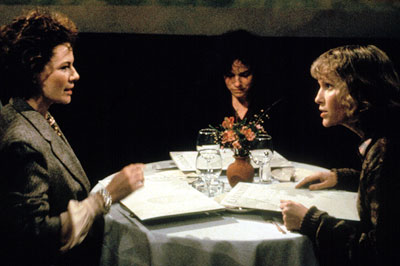
I was surprised, but gratified when in the comments’ section of my review of Annie Hall love was professed for Allen’s Hannah and Her Sisters. If the 1977 classic is more then the (relative) serenity of Hannah and Her Sisters must certainly be less. But as the saying goes, less is more, and with Hannah and Her Sisters it’s true. Yet, in theory at least, Hannah and Her Sisters shouldn’t be so excellent. Its irrepressible good-natured manner in the face of disaster is a bit alarming – even for Woody. But when I think of Woody’s greatest, I return to this comedy because Woody has always done best when he takes a group of neurotic and sometimes perverse characters and turn their tales into something deliciously wonderful. Having the opportunity to visit these characters over three years gives him the ideal chance to examine all the things he loves – relationships, religion, family, careers – and he does so with aplomb.

Dianne Wiest, Carrie Fisher, Michael Caine, Max Von Sydow Mia Farrow Barbara Hershey and Woody himself. The man knows to work well with his cast members, thus Hannah and Her Sisters has that extra special something that makes it an almost peerless ensemble. Naturally Woody’s not for all, heaven knows why, but he isn’t. Still, when he’s on his game he’s supreme and every actor in the film is having a good time reading off lines from his Oscar winning script. When I made my list of memorable sisters on screen Hannah and Her Sisters missed by inch, but the relationship between Hershey Wiest and Farrow is wonderfully true. Sure, it’s not as quirky as the other trio of sisters that year but the focus is more expansive and Woody is careful not to make any one of them the “important” one – even if Hannah’s name is the only on in the title. I’m somewhat amused when I think of its name really, Hannah and Her Sisters seems like a misleading title. It is about the sisters and their work, but I’m unsure if that’s ideal name for it. But then, I suppose it’s an attribute of Woody. Annie Hall isn’t really about Annie Hall alone…is it?
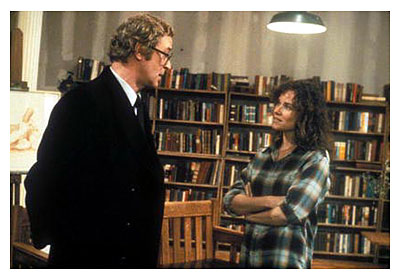
So, yes, Hannah and Her Sisters is my favourite Woody piece. It’s something that many fans would say, and I guess sometimes it pays to agree with the masses. Between this and A Room With a View I’m just slightly miffed that the Oscar went to Platoon - which is actually a good winner. But who cares? Prizes are prizes and yet Hannah and Her Sisters continues as a treasure to the comedic genre. It’s troubling though, even though it’s remembered as one Woody’s best I don’t hear as much about it as I’d hope. Sure, it’s been over twenty years but it’s still worth remembering and falls at #13 on my list of favourite films. I’ll always remember Woody’s manic search for a religious epiphany in the film, a scene that has become a bit too spoofed in recent times…what do you remember first when you think of Hannah & Her Sisters (and their men)?
Wednesday, April 7, 2010
1994: Get Out Of Jail...and Go to Broadway
People always lament the state of 1994 because Pulp Fiction lost to Forrest Gump. You know me well enough to discern that I’m not too hot on Tarantino (even if I will admit that Pulp Fiction is one of his more tempered pieces). The thing is, neither of the two was the best film that year so it’s really an argument to no end. Morgan Freeman is a bit of an anomaly as far as I’m concerned. I genuinely like the man, and he’d be somewhere in my top 100 perhaps even my top 50 actors but I’m never particularly fond of his performances. Time after time, he just seems to be on autopilot. Still, I can let these moments of autopilot pass because there is one Morgan performance that never fails to impress; his enviable performance in The Shawshank Redemption. It’s a brilliant performance that stands out in an ensemble. Incidentally, the same can be said for Dianne Wiest in Bullets Over Broadway, the other juggernaut from 1994. Woody has always had a thing for big casts, and in Bullets Over Broadway (though not his best film) he found his most expansive and talented cast. It’s a bit of a tug-of-war for me when I think of 1994. On one hand lies the sedate and poignant Shawshank Redemption and on the other hand Woody’s atypical comedy of show business Bullets Over Broadway.

The two films could shake hands when it comes to their heroes. Tim Robbins has gone on to win an Oscar, but he and John Cusack have much in common. Both have thing for playing the innocuous heroes, and in both The Shawshank Redemption and Bullets Over Broadway they’re surrounding by a group of zany characters. I suppose the similarities stop there. Andy’s incarceration at Shawshank is a far cry from David’s predicaments in New York. It’s weird, though, that Shawshank Redemption made a mere 25 million at the box-office, but it’s even more ridiculous when you realise that Bullets Over Broadway made just about half of that. What’s the reason? The films are conversely different, each playing to different emotions and yet neither found (immediate) success with the audiences. I like to think of Bullets Over Broadway as Woody’s most structured film. It’s not my favourite of his, but it’s easily the tightest (it’s just below 100 minutes), and the script is just so quick-paced. The Shawshank Redemption goes on for well over two hours, and though it’s based on a novella, it never drags. Presentation is everything, really. The quickness of Bullets Over Broadway is as essential to the joie de vivre of New York as the meticulous detail is necessary to the jail at Shawshank.

Darabont makes The Shawshank Redemption sneak up on you, a little. I always seem to forget that it’s such an ensemble piece until after I’ve seen it. It’s the opposite with Bullets Over Broadway. It’s so short, and it’s not really about everybody, but it seems so. Sure Morgan Freeman and Dianne Wiest each seem to think that they’re the leads in their respective piece, though. Morgan...I like him much, but I like few of his performances. Still, I won’t argue with the brilliance that is him in The Shawshank Redemption. It was the perfect opportunity to give him that Oscar, but at least Dianne got hers. On the subject of Oscars, though. It’s so weird that neither Tim nor John went nominated. As brilliant as Morgan is, Shawshank depends completely on Tim he easily trumps the majority of that sorry actor lineup, so does John actually – and three of his co-stars were nominated. Both films actually went home empty handed for the most part, between the two of them they racked up 14 nominations and the only one was for Ms. Wiest. They should have at least won their respective screenplay categories, but why am I lamenting on the fickle Oscars?
The Shawshank Redemption is a brilliant ensemble drama, a poignant tale and a story worthy of remembrance. I know three people who are very fond of this film – Emma, M. Carter and The Mad Hatter. Three people whose opinions are valuable, and they’re not wrong. The Shawshank Redemption is that good. Unfortunately, Bullets Over Broadway doesn’t seem to have as many people championing it, but it’s just as good. The Shawshank Redemption ranks at #43 on my list of favourites and Bullets Over Broadway at #35.
What were your thoughts on 1994 in film? Is either of these your favourite?
Friday, February 12, 2010
Parenthood
NBC are premiering a TV adaptation of the 1989 flick Parenthood with Lauren Graham and Peter Krause. I don’t know if I’ll watch but I sincerely hope that it’s a success. I’ve adored Lauren Graham for all the years she was Emmy snubbed doing excellent work on Gilmore Girls and though Michael C. Hall was the real find for me on Six Feet Under I remember Peter Krause with fondness alone. But to be honest they’re not the only reason I’m hoping for success with this show. The 1989 comedy Parenthood is a film that I admire. It is after all #51 on my list of favourite films, and in a list that has already scene gems like The Talented Mr. Ripley, Who’s Afraid of Virginia Woolf and Dead Man Walking lower down you can understand just how much I love it.

Have you seen Parenthood? I wonder what your excuse is if you haven’t. It is – as you can surmise – about being a parent. It is an unenviable job at the worst of times, but Parenthood is a comedy so it’s more than about the bad times. I remember Parenthood and immediately remember the luminous Dianne Wiest who earned a second Oscar nomination (Supporting Actress, naturally) for her work here. She plays a single mother with two children. Her daughter is engaged to Keanu Reeves – so you can just imagine her troubles; and her younger son is questioning the whereabouts of his father who has another family. You probably know by now, but I’m excessively fond of this woman. She is so talented (and simultaneously underused) that it’s not even funny. Dianne Wiest is one of the two women who are able to make Keanu Reeves youthful machinations bearable – the second is Glenn Close. Dianne is both comedic and dramatic in her role, and it’s a bit tough at times. She has to show us the ferocity of her motherhood but she has to be easy going enough to let that questionable DNA of Reeves into her family, and she has to make it all mesh together. She does. When she comforts her son in a pivotal scene you cannot help but feel for this woman. Parenthood is not only about Ms. Wiest though. We have other families, notably – Rick Moranis and Steve Martin. They’re not Dianne Wiest but the two men are good here. They opt out of their usual physical comedy and do some excellent work. Moranis in particular is good as a torn father. I can’t remember Parenthood without remembering those child actors who are just adorable.
Parenthood is a comedy, and it’s an ensemble piece. It’s funny, but it’s real. It’s strange I suppose that in a year of Driving Miss Daisy, Born on the Fourth of July, Crimes & Misdemeanours that this off kilter comedy was my favourite film; but it was. It is absolutely enchanting.
Do you think I'm crazy? Or does Parenthood give you happy thoughts?
Subscribe to:
Posts (Atom)


