Showing posts with label Colin Firth. Show all posts

Saturday, February 26, 2011

Oscar Talk: Because I Can (Final Oscar Predictions)

I didn't even realise that I went this crazy with talking Oscar this past season (all entries), it implicitly suggests that I was invested in the season - which I wasn't, but ah well. I do feel the slightest bit saddened that the season is over. Oscar's like one of those friends you can't stand to talk to often, but you'd implode if they died. So, ahoy - final final predictions.
       
Picture: The King’s Speech
Director: David Fincher for The Social Network
To tell you the truth, I wish I had the guts to predict The King’s Speech for both honours – but I’m hoping me not predict it will somehow make it not happen. Not because I’d mind Hooper winning that much (I won’t) – but I could only fathom the uproar that will occur if he does win the Oscar. And, I like the guy – don’t want him mauled. Either way, though, I’m fine. Both films and directors would appear somewhere in my top 10 – so I don’t mind what happens either way. (I’m still hoping for a delicious upset via The Kids Are All Right, but yeah, I’m fine either way.)
          
Actor: Colin Firth in The King’s Speech (alternate Javier Bardem in Biutiful)
Actress: Natalie Portman in Black Swan (Annette Bening in The Kids Are All Right
So, Colin and Natalie? Je ne sais pas. It’s a tossup (in my head at least) for the acting race – but I’m willing expect my favourite to lose. Now that I look at it, though, I want Annette to win even more (apparently it IS possible). Remember she and Colin were in Valmont way back when. Wouldn’t it be nice to see them win Oscars together?

Supporting Actor: Christian Bale in The Fighter (Geoffrey Rush in The King’s Speech)
Supporting Actress: Helena Bonham Carter in The King’s Speech (Alternate: Melissa Leo in The Fighter)
So, will HBC finally reach the podium 18 – or is it 13 – years after she deserved to? It depends on who you’re talking to pinpoint the precise year she deserved it, but she has before. Not for her Queen Mother, but do I care? No. I could be wrong, perhaps me wanting it means it won’t happen, but I’m sticking to that prediction. And, I suppose a Bale win is inevitable – which is fine. That pipedream for Ruffalo died long ago (though, I’ll admit I’m still pretending he’s winning in my head).

Original Screenplay: David Seidler for The King’s Speech (Alternate: Christopher Nolan for Inception)
Adapted Screenplay: Aaron Sorkin for The Social Network (Alternate: Michael Arndt, Jon Lasseter et al for Toy Story III
People are still predicting an Inception upset – which I swear would make me so infuriated I’m actually worried it’ll happen now. Look, fine I’m not a big Inception fan – but there’s such a colossal difference between originality and writing. The award seems skewed because it says “original writing” and not “screenplay from material previously unpublished”. Ah well, we’ll see what happens... I say it’ll be the two frontrunners for the Picture category with Sorkin and Seidler triumphing. And, since Cholodenko has no luck – I’m fine with these two choices.

Art Direction: The King’s Speech (Alternate: Inception)
Makeup: Barney’s Version (Alternate: The Wolfman)
Costume Design: Colleen Atwood for Alice in Wonderland (Alternate: Jenny Beavan for The King’s Speech
Now that I think of it, Art Direction could be a huge toss-up. Sure, The King’s Speech and Inception seem like the frontrunners – but there’s no telling how voters will respond to the obtrusiveness of Alice in Wonderland, and I sort of don’t see True Grit going home empty handed either. Aaargh, then there’s makeup which I’m really just guessing about – and them, Costume Design where I want Colleen to win because she’s the best and I want her to get her third statue, and then there’s Beavan who was snubbed for such great work in the 90s and did such good work on The King’s Speech which I’m not-so-secretly hoping will sweep the ceremony just for the fun of it. Decisions, decisions....

Sound Editing: Inception
Sound Mixing: Inception (The King's Speech)
I decided to go two for two with Inception here, because the sound branch seemed sort of insular in choosing The Hurt Locker last year. And, though, it’s possible they just thought it deserved both – and though Inception is nowhere near frontrunner status – it’s a possibility that seems logical. Now, The King’s Speech (or more realistically True Grit) could upset in the mixing category – but I’ll say no.

Cinematography: Danny Cohen for The King’s Speech (Alternate: Wally Pfister for Inception)
Editing: Kirk Baxter and Angus Wall for The Social Network (Tariq Anwar for The King’s Speech)
Visual Effects: Inception (Alternate: Alice in Wonderland)
Okay, I think this is the point where I’m getting ridiculous. Honestly, I can really see Cohen upsetting for photography in the same way that something like The Golden Compass upset for visuals or The Bourne Supremacy upset for sound. And, then I could see the obvious happening and Deakins winning or Pfister winning. Ugh, this is only a conundrum because I’m over-thinking it all – and I know I’m over-thinking it, but I can’t help over-thinking. This reminds me why I opted to show no interest in Oscar last year. I think the editing prize is assured, though. No? And the visual prize seems assured, but I think I’ll laugh if Alice in Wonderland (undeservedly, I’d admit) wins.

Original Score: Alexandre Desplat for The King’s Speech
Original Song: Alan Menken for “I See the Light” from Tangled
We all know how surprising the music branch can go when it comes to choosing winners (case in point: 2005, an exercise in strangeness). Will Desplat and Menken – the deserving – win? Will Zimmer and Rahman – the loud and the obvious – triumph. Will we go even crazier and reward the laidback ones like Reznor and Newman? I’m sticking with the first options.

Foreign Language Feature: Incendies (Alternate: In A Better World)
Documentary Feature: Inside Job (Alternate: Waste Land)
Animated Feature: Toy Story III (Alternate: How to Train Your Dragon)
I have a feeling Incendies is going to win, if only because most people who’ve seen the films admit that it’s terribly mawkish. I have that sort of little faith in the voters, although you’d think them having to watch the films in succession mean the best will win. I can’t be certain, Incendies just seems like a typical choice even if I want to say In A Better World. I’d sort of love Dogtooth to win, just because this guy here loves it – and it’ll probably make him happy. I’m sticking with Inside Job for documentary – just because.

Short Film (Animated): Day & Night (Alternate: Let’s Pollute)
Short Film (Documentary): Killing in the Name (Alternate: The Warriors of Qiugang)
Short Film (Live Action): The Confession (Alternate: God of Love)
I’m honestly stabbing in the dark here, and I sort of love it. I always do zero research for these categories and just choose based on name of film and directors. It’s always fun, but don’t take me seriously here. I have absolutely no authority.
                        
Well, Oscars are in about 18 hours or so. How was the season for you?

Friday, February 25, 2011

Oscar Talk: Actor and Actress

I often wonder why the actor and actress categories are considered superior to the supporters, but judging by the nominees this year I’d actually support that theory. The nominees for the leading categories significantly outweigh the supporting players.
            
ACTOR
Who’d have thought that Colin Firth would be the thespian to reach here before his contemporaries like Neeson, Branagh and Fiennes – but, that’s Oscar for you. He gets an immediate second shot at gold over last year’s loss, and he’s not likely to lose.

NOMINEES: Javier Bardem in Biutiful / Jeff Bridges in True Grit / Jesse Eisenberg in The Social Network / Colin Firth in The King’s Speech / James Franco in 127 Hours Prediction: Colin Firth Alternate Javier Bardem

I should probably qualify that alternate prediction by saying that of all the feature film categories this is the one where I believe an upset is likely. Still, at this rate, if any upset were to occur it would be one of catastrophic proportions – and who better than the man who turned into (somewhat) of an upset nominee. Analysing the field, on performances, I’d say that the prize is between Eisenberg and Firth so I don’t mind that Firth has sort of swept through the season, even if some deserving men got no love (my ballot). I never actually considered Sean Penn’s Milk to be an upset, the last real “surprise” this category saw was Adrien Brodey, but parallels between he and Eisenberg are tenuous at best. It’s Colin’s race.
         
ACTRESS
Logically, I shouldn’t be getting any sort of headache with the prediction for this category because Natalie has sort of swept through the season, well the majors anyway – but I’m still not absolutely certain that she’s the indisputable winner. Hell, it’s possible that I’ll see her on stage with the winning statuette and still doubt the veracity of her frontrunner status – I’m sort of ridiculous like that. I was depending on the BAFTA to give Annette the statue, and prove my theory whereby the Annette/Natalie race would turn into a converse version of the Marion/Julie race (both win Globes, one wins SAG and the other wins BAFTA) – but alas, I was wrong. Logically, if Annette had any hope you’d expect her to take at least one major from Natalie – but other than the surprise British Critics' win (which isn’t exactly a major) she's got nothing. And she still lost the BAFTA, so there’s no proof that she has the British voting bloc behind her.
           
NOMINEES: Annette Bening in The Kids Are All Right Nicole Kidman in Rabbit Hole / Jennifer Lawrence in Winter’s Bone / Natalie Portman in Black Swan / Michelle Williams in Blue Valentine

Prediction: Natalie Portman Alternate: Annette Bening

So, I’m predicting Natalie – which makes me feel a little bit like a Judas because I still think that Annette can win this. I’ve never been one to have ridiculous Oscar hopes (I gave up on Cate winning for I’m Not There even before Tilda t urned into the frontrunner) but I’m just getting a feeling, heaven knows what it is. (Really, though, how ironic is it that a win for Annette would be an upset – mindboggling, some.) So, Natalie’s my prediction with Annette as my alternate. You all know what I’m hoping for, though....(my picks)
         
How ridiculous are my great expectations of an Annette win? Who wants an upset in the Actor category?

Friday, February 18, 2011

Encore Awards: Actors

It’s been an unusually good year for the leading men. I look at the Academy’s list of nominees, and even though one in particular sticks out oddly– it’s not a terrible performance. I could easily flip-flop between my actual list of nominees and the six finalists and still be satisfied with whatever top 5 I come up with. This was actually the category that gave me the most indecision in choosing nominees; never has a list of nominees felt so arbitrary, even the winner is debatable. Last year Ben Whishaw in Bright Star was an indisputable winner, but I’d be willing to give any of these five gentlemen a gold star. So, in the face of the generally bland showing of 2010 films it’s nice to see such good male performances.
        
(Click on the photos of the gents for full-reviews of featured film)
         
THE NOMINEES
Stephen Dorff in Somewhere (as Johnny Marco)

Coppola is so interested in getting that listless tedium of real life down Dorff is forced to play the part through expressions and not dialogue, and he succeeds impeccably. Coppola’s lucky that he has the sort of open face that’s able to convey the blandest of emotions without making them seem hackneyed, so all those somewhat injudicious close-ups work incredibly well. He doesn’t make Johnny into two irreconcilable characters – the father and the actor – they’re one and the same, both of them hopeless cases so when that emotional breakthrough (breakdown?) comes towards the end it’s not completely unexpected, and not at all forced but it’s still profound and moving. (Highlight: Breakdown)

Aaron Eckhart in Rabbit Hole (as Howie)*
As the narrative of unfolds, you realise that Howie seems bland around Becca, not because the character is substandard or because Eckhart is not trying hard enough; it’s because Eckhart’s Howie is aware of how tenuous a grip on life his wife has, he’s just making the decision to be silent about it, which is why those looks he steals her way in the first half hour become so important. He’s just as tightly wound, and has even more trouble opening up to those around him because no one expects it of him. That’s why that argument with Becca comes off as more soliloquy than conversation, he has a whole lot of pent up rage inside. That adage of still waters running deep couldn’t be more significant. (Highlight: Walking the Dog)

Jesse Eisenberg in The Social Network (as Mark Zuckerberg)
There are times where’s he’s just a bit excessive with the physical tics, but the moments where he succeeds most are the deposition scenes where he’s able to merge the potentially arcane reasons beneath Mark’s ostensibly reckless behaviour against the somewhat wiser and still very gauche sensibilities of his present day sense. He just might get off with playing up the eccentricities of the character in earnest, because since it’s a real person he has a smokescreen to hide behind but he ultimately wins because he decides to carve Mark’s most piercing moments around more than just those tics, while managing not to let the inevitable vulnerability within become too much of an absolution of his less attractive qualities. (Highlight: “Does that answer your condescending question?”)

Colin Firth in The King’s Speech (as King George VI)
Because of the manner in which Seidler opts to establish Bertie’s idiosyncrasies Colin is obliged to characterise Bertie by the relationship he has with those around him. The rapport between he and Rush emerges as most obvious, but three significant moments of his play out opposite other performers. It’s easy to play the psychological motives behind his stutter trite, and Hooper and Seidler are lucky that Colin doesn’t play them as such. You can trace the moment he shuts down opposite his father, or note the self-deprecating way he speaks to his brother or the ways he opens up – or conversely closes up opposite his Queen. He’s anomalous in the way he keeps his emotions close to his chest, but reveals them under pressure – and Firth ensures that the transition between the two is natural. (Highlight: Either A Story for his Girls or A Bedroom Conversation with his Wife)

Ryan Gosling in Blue Valentine (as Dean)
Gosling has a natural ambiguity to him that makes him all wrong for the palpable villainy of his role in All Good Things but perfect for the role of Dean here. Unlike Williams the narrative isn’t as interested in his back-story, so it’s up to him to create that impression of a real person with underlying issues – and not just in the more obvious scenes. Thus, the ambiguity ends up working – excellently – to his advantage as he manages to avoid any propensity for playing the character like a villain, instead finding the most sincere emotions in a man who’s sort of drifting through life, but who we don’t loathe. (Highlight: Pleading his case at the film’s end)

FINALISTS: Leonardo DiCaprio brings that same sort of intensity that has defined his recent performances to his Teddy in Shutter Island, but it’s more than an exercise in something he’s already done. For one, he must carry the entire film on his shoulders and he succeeds even when the narrative gets too pulpy; James Franco in Howl; even if you ignore the fact that this is James Frecheville debut, his performance in Animal Kingdom is still something special. Unlike his supporting cast, he must establish his characters through the most tacit of inclinations – and he delivers from that opening scene; this time around with Fuqua Ethan Hawke examines a different side of his range in Brooklyn’s Finest; in the same way that Hamilton avoids the temptation to make Night Catches Us the stereotypical racial drama Anthony Mackie does not give in to the possibility of turning Marcus into a formulaic “angry young man” – he grounds his character in a firm sensitivity that becomes one of the film’s strongest suits; Ewan McGregor doesn’t come off as particularly mysterious but he manages to be something in The Ghost Writer. It’s his film, and though he carries it on his shoulders he does so unobtrusively knowing when to recede for the supporting players to shine but always ready to take control again.

SEMI-FINALISTS: Collin Farrell eschews his most obvious calling cards in Ondine deciding to establish Syracuse with a steady reticence that feels like under acting but isn’t really. He’s not the film’s main enigma, but he manages to be even more mysterious by playing his emotions so close to his chest and still never being disingenuous; I’d give James Franco an A for effort in 127 Hours, simply because you know that he’s doing the best possible job he can with what he’s effort – and you know that he’s relishing it. Sometime he falls victims to Boyle’s own intent to evade the harsher tones of his character but ultimately it’s his performance – and little else – that’s able to evince any semblance of emotion from the stony narrative; Aaron Johnson needs to establish that certainty of charisma in Nowhere Boy without “playing” John Lennon, and he does it with startling adeptness – at least from where I sit. He’s still rough around the edges as a performer, but he (and Taylor-Wood) use that newness to his advantages making Lennon a fine example of someone trapped by his surroundings, but not melodramatically so; Kodi Smith-McPhee is even better in Let Me In than he was in The Road. He’s not the one playing the “old” character, but he imbues Owen with all the emotional complexities that you’d expect from an older thespian and delivers on the facial expressions when Reeves roots the film in the visuals and no dialouge; sometimes you get the feeling that someone else could have done the title role in Baumbach’s Greenberg better, but that doesn’t mean that Ben Stiller isn’t doing good work. He’s slightly unsubtle as we first meet the character, but the rapport he strikes between Gerwig and (especially) Ifans reveal a warmer side to him as an actor (and the character) that’s surprising and impressive; Mark Walhberg in The Fighter

Who’s your best actor of 2010?
       
*I already want to rejudge and give Dorff the gold and perhaps allow Firth or Eisenberg to slide into silver. There ALL so good!

Wednesday, January 26, 2011

The King’s Speech

Sitting down to review The King’s Speech is a chore in itself – and I’ve been putting it off for such days. It’s difficult to separate the film from the currently (somewhat vague) antagonism that’s surrounding it in the face of its recent PGA win and Oscar nominations and, more so when I think about how long I’ve been waiting to see it. Hooper, often interested in touching on big names in history, turns to King George VI for his latest monarch’s relationship with his speech therapist – the Australian Lionel Logue. As Lionel and Bertie continue through the slog of familial issues and their effects on speech the King is faced with alternating pressures on the home front, a caring – if vaguely detached wife, a seemingly disappointed father and a caddish brother. The King’s Speech is a film that’s unconventional in its conventionality. True, the tale has little to suggest that it’s anything daring or brash but screenwriter David Seidler decides to root the film in a placidness where plotpoints develop not in the usual cinematic spurts but expand sedately – even lethargically – easing along, bit by bit.

It’s an approach that’s necessary because Hooper and company are interested in assessing Bertie not in relation to anyone else but in relation to himself, which renders The King’s Speech extraneous political affairs well, umm, extraneous. It sets itself up as a psychiatric drama, because you’d more likely have reason to measure this against The Prince of Tides (the middle portion at least) where a pleasant doctor aids someone with a troubled past than The Madness of King George an ostensibly similar story of a monarch at odds with himself and those around him. There’s no evidence to suggest that Hooper IS interested in making a prototypical monarch piece but his vision reeks of being indistinctly insular at portions at times because the staunchness with which the focus appears on Bertie and Logue gives the film a feeling of limitedness. Sort of like a dance with two players, but a host of superfluous – if diverting – participants meandering around; reminding me a bit of O. Russell and his occasional inclination to forget that The Fighter should be an ensemble drama.
It’s not that Hooper’s vision is dissonant in discerning what his film is about, but the supporting players around are on their own interesting enough to demand pertinent bits of storyline that their sorely lacking. One of the scene that plays out best in the film has George’s wife (a very serene Helena Bonham Carter) having a chat with Mr. Logue – Rush’s first appearance on screen. This meeting suggests things in both parties that you think would be addressed, but aren’t. Bonham Carter plays with just the right winsome air where she’s the standard Queen with just a tinge of snob about her (tea at the Logue’s) that’s not off-putting but part of her attraction. As interested as she is in ridding Bertie of his issues she’s not exactly driven by devotion, it’s an arc – their entire relationship – that seems especially perplexing when you’d expect his marriage to play as important a role in his speech as his family history. Measure that against Pearce’s cavalier older brother (probably the best work I’ve seen from him) who’s the right amount of cheeky and sanctimonious – without ever being despicable. Firth thrives against them both, so it seems a bit of a disservice to the narrative to have emotional peaks of the story develop behind closed doors – even if the metaphor there is amusing.
And, it’s not to say that the story that we’re actually given is poor – because the alacrity of the screenplay is one of the most charming things about the film. It avoids the most simplistic of traps by stopping the narrative just before George (with Elizabeth) experience seismic popularity. It’s a sort of representation of what Hooper and his company does best – he’s always able to prevent over-saturation. There’s something a bit too on-the-nose about the adage “less is more” but Hooper knows it well. He knows when to cut scenes and moreover when to END the story because as much as The King’s Speech has potential to tell us more it also has obvious potential to be overwrought which The King’s Speech avoids – it’s too classy for that. The thing is, it’s that sort of classiness that wafts over you after perusal, and though I’m not especially prone to the more obvious but sometimes Hooper’s penchant for subtlety descends into innocuousness. And, yes, in the end the payoff works because of – and not in spite of – that opting for a conclusion that’s enduring in its smoothness that I can appreciate for being so well done. It's a bit like Hooper was internalising the DESIDERATA and it's famous advice, go placidly amidst the noise and haste and it does do placid beautifully. It's not a discredit to the film that's it's more interested in the introspective than the extrospective, and yes it errs when it comes to examining those around Bertie. Sure, I'll admit I wanted better, but that's not really a judgement on the film itself - what was served up was perfectly fine, circumscribed on occasion  - but laudable.

B/B+

Saturday, January 15, 2011

Oscar Talk: The Best Actors

It would seem that the best Actor race is all but sewn up with Colin Firth getting the Oscar that more than a few felt he was robbed of last year. I wouldn’t say that he was robbed, but of the five nominees he was my favourite, so good for him. I’ve still yet to see The King’s Speech – the only Best Actor lock I’ve not screened yet – but putting all things into consideration: timing, picture, likeability – he looks like a sure bet. Who’ll join him? Jesse Eisenberg (The Social Network) and James Franco (127 Hours) seem like locks for a nomination and the last two spots seem open. Of the set fighting for a nod I still say Robert Duvall will get it definitely, even if True Grit has turned into a blockbuster I believe there’s more goodwill for a Duvall nomination – Crazy Heart aside, the AMPAS don’t seem that smitten with Bridges – case in point, look how long the man waited to get that Oscar that everyone kept saying he was so “overdue” for. I suppose I’m not counting him out entirely, in fact that, right there, could be the nominated five. Ryan Gosling is waiting just below for some love for his work in Blue Valentine but there’s really not much buzz for that. I’m still somewhat surprised that in a year of two high profile flicks Leonardo DiCaprio has turned up at only a few precursors. His Shutter Island work is superior, but the film has failed to make a mark in the race and Inception hasn’t become the all encompassing ruler of the season – so he can’t depend on either.
                
This does make for an especially boring race, but that’s awards’ season for you.

Predictions: Jeff Bridges in True Grit / Robert Duvall in Get Low / Jesse Eisenberg in The Social Network / Colin Firth in The King’s Speech / James Franco in 127 Hours /

Are your tired of me fêting Rabbit Hole? Tough; Aaron Eckhart should at least be a contender in the race – but alas, no love for him. That’s a shame, considering that the man gave the best performance Jason Reiteman has ever directed and managed to go toe to toe with the Queen of Hollywood herself in her best performance.

What’s your biggest gripe with the Best Actor race? Which actor are you shocked has received no attention?

Tuesday, February 16, 2010

2009 in Review: Growing Older…

It’s not regarded as a specific genre in and of itself, but it’s always interesting to note how many films tackle that “taboo” subject of growing old. Not coming age as from childhood to maturity, but the (sometimes sudden) realisation that death is imminent, dreams will not be attained and life is not what you wished it would be. It often becomes a question of our mortality. Stephen Frears Chéri is the ultimate example of being disillusioned about growing older, since the subject is that of the aging courtesan Lea de Lonval (played by a magnificent Michelle Pfeiffer). It’s a film that deserved more than it got, I for one was a fan – my review. Lea is growing older and realises that her treasures may not be as…valuable as they once were. The romance she thrusts herself into with the eponymous Chéri is pathetic, funny and poignant all at once and of course that (now notorious) final look in the camera tells more about the old enemy time than quite a few have tried in their entire duration.
The concept of age was a major theme in 17 Again, a surprisingly enjoyable comedy starring (who’d have imagined) Zac Efron. Matthew Perry’s Mike after realising the lack of mobility in his job that his golden years are long gone, and as we all do when the time comes, he yearns for the (assumed) simplicity of his youth. Of course the wrap-up is just a bit too tidy, but he learns in the process that we can never really outrun our problems, no matter how we try. It’s something I wonder if Clooney’s Ryan Bingham was considering. I really couldn’t buy into Up in the Air, the all too pithy scenarios felt much too clinical for me to believe. It’s not to say that Ryan’s epiphany is impossible, so many have probably gone through such a midlife crises but despite it’s numerous faults 17 Again spends its entirety trying to make us buy a change in Mike's temperament, so that when it comes – as tidy as it is – we are inclined to believe. On the other hand with Up in the Air, though I believe it could have happened I was not given any incentive  to believe it did. A wedding does not a marriage make and as epiphanies come they are sudden but there’s always an underlying rationale or raison d’être which continues to elude me when it comes to Clonney's Ryan.
I wonder where Larry David’s Boris from Whatever Works would fit into this equation. I suppose Whatever Works is Woody slumming it, but Woody slumming is better than many “excelling”. Still, Whatever Worksas I’ve noted – is not perfect. For the most part, the troubles begin (and end) with David. He’s not the lovable old geezer that we’ve come to expect and require in Woodyland. He’s all too abrasive. But Whatever Works manages to work where Up in the Air doesn’t because Whatever Works has the sense to realise that Boris is not the beginning and end of the narrative. The supporting characters essentially hijack the third act (for the better).
        
The only thing our other two women Robin Wright Penn’s Pippa Lee and Meryl Streep’s Jane have in common is a daughter played to perfect irritation by the exasperating Zoe Kazan. But then, I’m being too stingy. They both are juggling two men, even if they don’t realise. I wonder what Pippa would say to Jane. Pippa’s husband like Meryl’s ex has an indiscretion with a younger woman. But Winona Ryder is nowhere as savvy (or cutthroat) like Meryl’s foil the lovely Agnes. The Private Lives of Pippa Lee did impress me more, even if it is more of a guilty pleasure type. However despite the review, the first two thirds are quite good. I realise too, that both films depend completely on their leading ladies. Both come to grips with their age, although it is harsher for Pippa considering that she’s no where as exciting as she was in her youths. They both may be juggling two men, but she’s not a bit of slut, but then neither is Jane for that matter. The real slut would have to be Lea, and that’s purely for professional reasons.
   
The two films which were so easily confused last year A Serious Man and A Single Man. The latter obviously trumps the former for me. Although I’m not acutely certain that either man is really dealing with midlife crises. Both men are teachers; that’s about as far as their similarities go. Larry is the epitomical good guy who bad things happen to, but so is George. Larry looks to religion and George looks to death. I’m not sure either of them finds complete fulfilment. But then again, who does?
       
At the end of the day Lea’s mirror gaze haunts me the most; but which battle with age leaves you must satisfied…cinematically speaking? 
         
PS. This is the last of the 2009 in Reviews...unless there's a category I've forgotten...

Wednesday, February 10, 2010

A Crazy Heart, A Single Man and a Ridiculously Bright Star

 DON'T FORGET TO PLAY THE GAME!
          
I’ve seen the last three films I needed to before I began my year end awards. I’ve not written reviews for Away We Go or The Imaginarium of Dr. Parnassus – chances are I won’t, in fact the three films identified in the title won’t exactly be properly here, even though two of them deserve mellifluous words. Still, it would be remiss of me not to at least mention them even though they are quite different. Crazy Heart gives us the second coming of Jeff Bridges, or so I’ve heard. It’s the third significant time that an actor is going all musical on us. Jamie Foxx won his Oscar for it and Bridges will probably follow suit, but my favourite of the lot is the unsung Joaquin Phoenix for his real blooded Johnny Cash. It’s strange since Bridges’ has the chance here to create something new, his character is his creation after all. He’s fine, good even, but I wondered why I felt unmoved for so much of his journey since he has the most chance to move me, unlike Whishaw and Firth who must play vignettes.
          
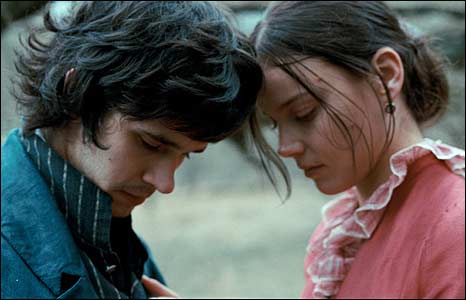
The chemistry exists between Bridges and Gyllenhaal but they seem so comfortable I don’t even feel that they’re trying. Crazy Heart is passable; it doesn’t do anything exceptional, even though I felt it wanted to. In the end it just all felt a bit too artificial, this strikes me as ironic since of the three films it’s the one that tries to be the grungiest, from the costumes to the drawls and the script. Much has been said about the bauble like qualities of Ford’s A Single Man. It’s not perfect, that I will say, and I didn’t fall (completely) in love with it. Nonetheless, it’s a good film with a fine performance from Colin Firth. Still, A Single Man reaches its most poignant when Julianne Moore comes on screen. It’s one of the best performances of the best performances of the last year even though it’s easy to ignore it. It seems like standard Julianne, though it’s not. Her Charley’s wild abandonment with George is only sadder when we see the longing in her eyes that we need not question. She doesn’t get served up a plum role like so many women did last year. Her performance depends on her eyes as does Ben Whishaw’s John Keats. It’s an atypical male performance that unfortunately has gone unnoticed, but I’m not surprised. Audiences often fall into the trap of ignoring reactionary performances like this. But Whishaw's Keats is a revelation abd absolutely perfect. Cornish’s active Fanny Brawne is a thing of beauty, I can’t ignore her striking facial similarities to Nicole Kidman and her quiet line readings are so wonderful when juxtaposed with the moving amber in her eyes. This is her story, and not Keats and she gets the most emotional moment as she finds out Keats death. It is arguably the saddest moment of the last film year and Cornish shines, but she shines brightest when she blushes and smiles imperceptible with Whishaw.
           
It’s interesting that of the three Crazy Heart is the one most remembered in this time of awards praise. But then, it has the most typical female role – the woman behind the man, confident but never assertive. She is not Moore’s nonconforming Charley or Cornish’s modern Fanny. Crazy Heart, forgive me, plays up to the usual thematic elements that some audiences find it so easy to revert to. No surprise that Maggie Gyllenhaal’s turn has gained laurels, it being one of her lesser performances.
      
It’s obvious that Campion’s piece is my favourite then Ford’s stylistic narrative and the Bridges’ star vehicle as my least favourite. Strangely, grading isn’t even that difficult because it’s easy as A, B, C, in that order.
           
PS. See my Best Supporting Actor lineup, a star of the brightest is represented.

Friday, February 5, 2010

Forgotten Characters 2:4

It’s always nice when stars who’ve been acting for years get recognised as serious actors. Sometimes it’s a bit ironic, especially when these very actors have been doing their job for years. When a film is a favourite of mine I can’t be accused of forgetting any of the characters but I’m sure that many of you may have forgotten this man’s excellent performance in his first of two Best Picture winners:
                 
Colin Firth in The English Patient
As Geoffrey Clifton
             
The English Patient is one story that occurs in nonlinear format – on one side Count Almásy (Ralph Fiennes) along with his “International Sand Club” explore the deserts in the prelude to World War II. As we learn more about Almásy and his relations with married woman Katherine Clifton (Kristin Scott Thomas) we see The Patient (Almásy) after being disfigured by a horrible plane crash. As the wife of our heroine Firth makes his first appearance as he joins Fiennes troupe with his wife. We immediately see that he is quite devoted to her, even if he is a bit ingratiating. The film is a love story between Katherine and Almásy but it never tries to make Geoffrey into a villain – though he is not perfect. There is a scene towards the middle when he realises the affair on the night of their anniversary, it’s short and he does not have any lines but Firth handles it well. His involvement in a fatal plane crash towards the end angers the audience, but we don’t lose sympathy. As beautiful as it is to watch Katherine and Almásy we realise that for all his faults Geoffrey’s is dedicated to his wife and the pain that he feels at her betrayal is palpable. Of course, it’s no wonder that the character is forgotten since he’s not the romantic lead, but having yet to see A Single Man I single this out as my favourite performance of Firth.
              
Do you remember Colin’s Geoffrey? Or have you yet to see The English Patient?
          
Previously Forgotten...

Thursday, January 21, 2010

Signing Off...

By nature, I am an obsessive soul. Thus, whenever I get interested in something my appreciation of it is not often tempered and usually veers into the neurotic. Neurotic is probably an ideal way to describe my relationship with the Academy Awards. Even though the actual results were less than perfect that first time [re picture] I was hooked from the beginning. There was a time I could list [from memory] Oscar winners in the major categories from the mid-seventies onwards. I told you – neurotic. Even though I’ve gotten wiser in the missteps of the Academy I still [inadvertently sometimes] end up regarding that day in Spring as the culmination of all things cinematic. This year, however, the nominees have not even been announced and I’ve already become disillusioned, I fear.
             
The state of the race [a word more pertinent than we realise] had exasperated me before it even began. The fêting of Meryl Streep from the get-go already annoyed me. Sometimes it really doesn’t help not being a fan of Streep because she is the most ubiquitous actress [actor] at the moment. Nevertheless, despite my general my general apathy towards her I wouldn’t deny excellence if I see it. I'm always ready to recognise a good performance form her, which is why Julie & Julia disgusted me so much. Of course all these adjectives – best, excellent &etc – are completely subjective, but the only thing Julie & Julia did was confuse me as to the validity of its place in the Oscar race. I’ve never been fond of the accented Streep preferring her more subtle performances [her Clarissa Vaughn remains as one of my favourite portrayals of the last two decades]. Of course, she’s accented quite often but Julie & Julia regurgitated memories of Bridges of Madison County a film that only makes me see red. I finally realised my issue with Streep when I read this lucid article on the woman. It gets a bit snarky, but is a startlingly good read. It’s not that her Julia Child is a horrid performance. But, chameleon or not as someone who knows absolutely nothing of Julia Child her performance made me cringe at points. I couldn’t help but imagine the more unaffected Sigourney Weaver in the role. What really irked me was the residual belief that Meryl had been robbed of a third Oscar, this entitled to this win for Nora Ephron’s diverting comedy. It’s as if they had forgotten that La Streep has two Oscars – the entire debate of her comeuppance being extinguished by woman after woman was lost on me. What turned my disappointment in the Best Actress race into the deepest dredges of disgust was the addition of a certain Sandra Bullock. I’ve never bore ill will towards Ms. Bullock – her work in countless comedies from the inspired Ms. Congeniality and While You Were Sleeping to even the dubious Two Weeks Notice has always charmed me in their placid way. I saw The Blind Side late in the game, and although the term abject horror would be an over-exaggeration of my response it wasn’t far from it. I couldn’t even write a proper review the thought of the film annoyed me so much. Of course I’d prefer Streep’s flawed but superior Julia to Bullock’s uninspired Leigh Ann, but the very fact that that’s the end all of it is quite dismal.
                                                      
I’m yet to see the heavyweights for the Actors’ race. Bridges and Firth are not my favourite actors, but with the good roles I’m willing to board either train; but I can’t help feeling cynical and thinking that perhaps Bridges is not being rewarded for a [possibly] good performance in Crazy Heart but for lifetime achievement. Noble perhaps, but still annoying. When people like Ben Foster and even Sam Rockwell are ignored at ceremony after ceremony while Morgan Freeman – a man I admire without fail – can be nominated for his unimaginative Nelson Mandela only puzzles me, but is nothing compared to George Clooney’s moderately charming but lifeless Ryan in Up In the Air. But then I realise that with so many celebrating these pieces it’s not so much as unoriginality from the awards’ ceremonies than actual belief that these performances are the best of the year, which is even more disconcerting. If Freeman gets love for coasting in Invictus, why not Johnny Depp for Public Enemies?
Mo’Nique’s Precious win has many citing it as one of the imminent saving graces of the next award ceremonies and with her eclectic Mary Jones it wouldn’t be completely undeserved. But that category has become so auto-tuned that voters just seem to throwing the usual suspects together and ignoring quieter gems with potential to disturb the waters – Samantha Morton, Marion Cotillard [not only for Nine] on some days even Patricia Clarkson. I’m not saying that all of these women trump Mo’Nique, perhaps none of them do. I realise the ball’s completely in her court, and since I’m an undeterred fan of the comedian I don’t call foul. I’m worried that I’m missing something when Anna Kendrick keeps appearing on so many best-of lists, Seriously? We're touthing this performance? But, I won’t go there.  Again.
          
The race seems to have come down to Avatar and The Hurt Locker and scores have cried foul at Avatar’s Golden Globe win. Not me. I’m still undecided as to which of the two I’d give my vote to, but Cameron’s Avatar has turned into the film I’m rooting for. Not because it’s my favourite film of the year. It’s not. But despite it’s gigantic box-office it’s ironically tuned into the underdog. Someone, I can’t recall who, called it the tendency to hate the popular kid – which Avatar has turned into. I won’t deny the ostensibly potency of The Hurt Locker – it’s probably even more profound for Americans who know its themes all to well. Bigelow and Boal have crafted something wonderful, but the relegating of Avatar to some strange names “video-game movie”, “Pocahontas redux”, “stilted dialogue”, "stodgy acting" and on and on and on confuses me. Some people just don’t like it. That’s understandable, but I’ve never been a film apologist yet I can’t recall the ludicrously horrid dialogue of Cameron. I’m sure it wasn’t Oscar winningly quotable. But since when has Best Picture turned into a screenplay award? I understand the correlation between the two, but I can’t help calling foul when Avatar’s screenplay is advertised as one of the worst this year. But that’s probably one in the long list of things eluding my poor brain this Oscar season.
I’m signing off from this season. I doubt I’ll continue my four year long tradition of skipping school to hear the nominations live [embarrassing], and I’m definitely not inclined to join in predictions, though it’s always fun to read others. I’ve already committed to the LAMB’s 2010 production of Devouring the Oscars and will be writing on a Best Picture nominee. I’d love to see an off-kilter choice like Bright Star, The Messenger or Coraline. I’d prefer not to write on Invictus, Up In the Air, Inglourious Basterds or Precious. I don’t want to write a bashing post since nominations should be a happy thing. I’m sure at least a few of the nominees will be pleasing. Watching the Golden Globes though, I couldn’t ignore the number of sad [and sometimes angry faces] – Lee Daniels, Jason Reiteman, Quentin Tarantino, Jeremy Renner all looked peeved throughout. I wouldn’t have been backing many of them but I realised that each of the nominees want to win and deserved or not I wish them the best of luck. Being nominated has become less estimable and I can understand their apparent melancholies. But as far as Oscar is concerned, I've lost the drive. Let's hope next year is better...
Related Posts Plugin for WordPress, Blogger...