Showing posts with label Jeff Bridges. Show all posts

Saturday, February 13, 2010

2009 in Review: The Art of Making Art…

...is putting it together. 
                  
Films on forms of artistic ventures are a dime a doze, but I love them anyways. We have cinema to thank for giving us glimpses of so many famous people – the literary kind, sometimes painters, singers so often and this year though it was not quite as abundant it was satisfying. The film that took it the furthest had to be Marshall’s Nine. Nine took it even further than its musical source. In fact the entire Act Two is amended that Nine (the movie) turns into a film about making itself, it’s dangerously tongue-in-cheek and not typical musical territory. A psychological musical? Haven’t heard that one before. Above all else, though, Nine was about the difficulty of creating. In fact Guido’s plight can probably be understood by Jeff Bridges’ Bad Blake. He’s washed up, Guido is too, in a way. So is Adam Sandler’s George Simmons. Bridges is obviously the most sympathetic of the lot. What’s interesting is that each of these artists – the comedian, the singer, the director – tries to reach out to women. The reason Funny People falls flat though is that this very reaching out, though featuring an in form Leslie Mann, seems like an afterthought. The Soloist’s Nathaniel Ayers is not even as lucky. He’s not just experiencing a transition; he’s at the end of his line. I’m a bit surprised no one went for Fox’s portrayal, though it’s not my favourite of the year (not even close) – it’s better than at least two of the Supporting Actors nominated at…, but I won’t go there. The Soloist’s problem is that I’m not sure if it’s Downey Jr.’s journalist story of Fox’s demented man. Still, The Soloist is much better than it’s given credit for, even it’s just a bit too spotless.

                               
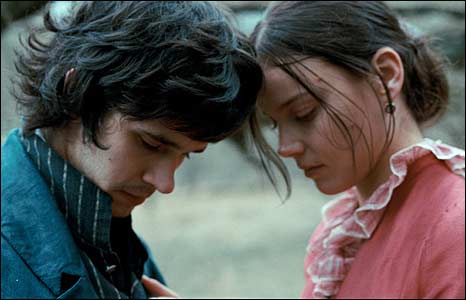
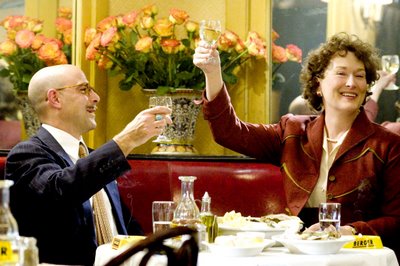
Whereas these three men are grappling with losing their gift John Keats isn’t even sure he has one. It is unfortunate that all brilliant men couldn’t have experienced the brevity their work has had, and John Keats has always been one of the more depressing ones. Next to Charlotte Bronte, he’s probably the writer of the era who least realised the future profundity of their work. Bright Star isn’t really Keat’s story – it’s Fanny Brawne’s – but he is imperative to the success of Bright Star, and Ben Whishaw epitomises all that is John Keats and yet, resists falling into the clichéd traps of the “sensitive man”. Still, I can understand Keats’s plight – like Wordsworth his style was atypical to the age. And on that note we can understand the plight of Julia Child. Whatever my reservations of Streep’s Child may be Julie & Julia works as a satisfying tale of conquering personal demons, of sorts. It’s funny noting how Child finds it so hard to find a place for herself, of course I knew nothing of the woman prior to the film – but it’s interesting note how success is mountain climbed and not a prize discovered. I suppose that makes it all the more worth while.
              
We had a singer, a comedian, a musician, a director, a poet and a chef. Which of these creators impressed you most?

Wednesday, February 10, 2010

A Crazy Heart, A Single Man and a Ridiculously Bright Star

 DON'T FORGET TO PLAY THE GAME!
          
I’ve seen the last three films I needed to before I began my year end awards. I’ve not written reviews for Away We Go or The Imaginarium of Dr. Parnassus – chances are I won’t, in fact the three films identified in the title won’t exactly be properly here, even though two of them deserve mellifluous words. Still, it would be remiss of me not to at least mention them even though they are quite different. Crazy Heart gives us the second coming of Jeff Bridges, or so I’ve heard. It’s the third significant time that an actor is going all musical on us. Jamie Foxx won his Oscar for it and Bridges will probably follow suit, but my favourite of the lot is the unsung Joaquin Phoenix for his real blooded Johnny Cash. It’s strange since Bridges’ has the chance here to create something new, his character is his creation after all. He’s fine, good even, but I wondered why I felt unmoved for so much of his journey since he has the most chance to move me, unlike Whishaw and Firth who must play vignettes.
          
The chemistry exists between Bridges and Gyllenhaal but they seem so comfortable I don’t even feel that they’re trying. Crazy Heart is passable; it doesn’t do anything exceptional, even though I felt it wanted to. In the end it just all felt a bit too artificial, this strikes me as ironic since of the three films it’s the one that tries to be the grungiest, from the costumes to the drawls and the script. Much has been said about the bauble like qualities of Ford’s A Single Man. It’s not perfect, that I will say, and I didn’t fall (completely) in love with it. Nonetheless, it’s a good film with a fine performance from Colin Firth. Still, A Single Man reaches its most poignant when Julianne Moore comes on screen. It’s one of the best performances of the best performances of the last year even though it’s easy to ignore it. It seems like standard Julianne, though it’s not. Her Charley’s wild abandonment with George is only sadder when we see the longing in her eyes that we need not question. She doesn’t get served up a plum role like so many women did last year. Her performance depends on her eyes as does Ben Whishaw’s John Keats. It’s an atypical male performance that unfortunately has gone unnoticed, but I’m not surprised. Audiences often fall into the trap of ignoring reactionary performances like this. But Whishaw's Keats is a revelation abd absolutely perfect. Cornish’s active Fanny Brawne is a thing of beauty, I can’t ignore her striking facial similarities to Nicole Kidman and her quiet line readings are so wonderful when juxtaposed with the moving amber in her eyes. This is her story, and not Keats and she gets the most emotional moment as she finds out Keats death. It is arguably the saddest moment of the last film year and Cornish shines, but she shines brightest when she blushes and smiles imperceptible with Whishaw.
           
It’s interesting that of the three Crazy Heart is the one most remembered in this time of awards praise. But then, it has the most typical female role – the woman behind the man, confident but never assertive. She is not Moore’s nonconforming Charley or Cornish’s modern Fanny. Crazy Heart, forgive me, plays up to the usual thematic elements that some audiences find it so easy to revert to. No surprise that Maggie Gyllenhaal’s turn has gained laurels, it being one of her lesser performances.
      
It’s obvious that Campion’s piece is my favourite then Ford’s stylistic narrative and the Bridges’ star vehicle as my least favourite. Strangely, grading isn’t even that difficult because it’s easy as A, B, C, in that order.
           
PS. See my Best Supporting Actor lineup, a star of the brightest is represented.

Thursday, January 28, 2010

Robin Williams, Jeff Bridges and The Holy Grail

The nineties had their share of comedies – from the usual stuff to the more sophisticated. Much of it was lost in the drivel, some deservedly so. However, one of my favourite comedies from the nineties is an oft forgotten piece, one of my favourites from 1991 and a film featuring the best work Robin Williams and possibly Jeff Bridges have done – as far as I’m concerned anyway – the title in question is The Fisher King. The Fisher King, is the story of a cynical former radio host  Jack[Bridges] who befriends a homeless man  - Parry -[Williams]. It turns out that an indiscretion by Jack has led to the unravelling of Paddy’s life. So at the urging of his girlfriend Anne [Mercedes Rhuel] he makes a move to help Parry find what he feels he needs – the Holy Grail.
                                    
The Fisher King is a comedy that veers dangerously close into the supernatural, but for all its humour it’s also vividly poignant. Robin Williams is known most for his comedic work, though he has excelled in the occasional drama. In The Fisher King he toes the line between both genres. Parry is a funny man, but he is also a broken man and Williams is able to show us the pain and hurt while still making us laugh. Jeff Bridges must play the straight man to Williams and he’s excellent as the cynical Jack I actually can’t say that either is better than the other. However, the highlight of the film comes with Mercedes Ruehl who earned an unlikely Oscar playing Bridges’ girlfriend. Like Whoopi Goldberg immediately before her and Marisa Tomei immediately after she is a huge source of comedy. Like Williams too she also needs to get dramatic and does it well. That is why her performance is a favourite of mine.
The Fisher King has unfortunately become forgotten. I don’t think that Terry Gilliam will ever be able to supersede the comedic yet emotional core of this. This is sort of the film that people see and it makes them feel happy without insulting their intelligence, the script is vibrant, the acting is excellent and it is a completely satisfying film. It’s an underrated gem of the nineties and at #66 on my list of favourites.
Related Posts Plugin for WordPress, Blogger...