Showing posts with label Natalie Wood. Show all posts

Tuesday, March 1, 2011

March’s Bloodstones: Wilma Dean Loomis in Splendor in the Grass

March the 8th marks International Women’s Day and most of you US citizens probably know of the month as Women’s History Month. I’m not American, but I still like the idea of March being the month of the woman, moreover when I think that its birthstones are aquamarine and bloodstones – gems signifying courage, and March was named after Mars – the god of War. It’s an interesting task, trying to discern courageous women in cinema – regardless of how many claim that there’s a dearth of female roles available, there’s a gamut of courageous women you could think of.
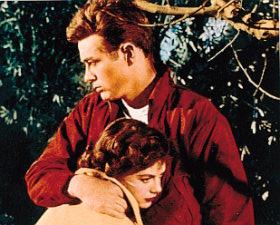
As I said, courage is a strange thing and you don’t immediately identify Natalie Wood’s brilliant Deanie with the typical encapsulations of female “hear-me-roar” courage on screen, she’s hardly combative. In fact, if you glance at the plot – a girl seemingly runs crazy after having sex – it sounds decidedly misogynistic and uncourageous. I like to think of Splendor in the Grass in the same way that I’d think of a William Blake poem – ostensibly supporting what seems like so messed up morals, while all the while actually subverting. The attitudes of women are an important part of William Inge’s screenplay. There’s that scene I love where Deanie and her mother are talking about sex and she says,
“Your father never laid a hand on me until we were married. Then I... I just gave in because a wife has to. A woman doesn't enjoy those things the way a man does. She just lets her husband come near her in order to have children. ”. 
It’s an unintentionally hilarious (but conversely, terribly disturbing line) and it makes the morals on which Splendor in the Grass is built seem sort of dated. But, for all its datedness the way that Inge and Kazan examine the age old theme of gender relations is quite interesting.
Like, Bud’s (Warren Beatty’s brilliant debut) sister – played to beautiful, albeit hammy, perfection by Barbara Loden. The film suggests, but never ascertains, that this is what the future holds for Deanie if she refuses to wise up and accept her role in life. Of course, that’s not really true – because, for all the madness that she endures she still emerges with a semblance of grace at the film’s end. And, it's not really madness that she undergoes in reality. I call it Natalie at her best, because she so often avoids the most obvious ways of making Deanie ridiculously crazy. Which takes me to the other important William of the film – Wordsworth. It is his poem that gives the film’s its name. It’s probably wrong to read too much feminism – if any at all – in Splendor in the Grass, but there’s something decidedly close to liberalness in that final shot watching Deanie drive away.
Natalie Wood has an inherent “superior” nature to her, that’s not quite condescending but still a little lofty (perfect example: the entire last half hour of Love with the Proper Stranger). And the look on her face as Deanie meets Bud for the last time is striking on so many levels. Not only because Bud looks like the guy who killed the goose that laid the golden egg, but that easily discernable look on Deanie’s face as she things that she could have had this life with him, then accepting that she doesn’t and then a sort of elation (in Natalie’s own subtle way) that she doesn’t. One isn’t naturally inclined to identify surviving with being courageous, but I like to think of Deanie as more than just a little courageous. And how can you not love Natalie in her greatest performance?
        
Is Deanie an appropriate start to courageous cinematic women?

Friday, August 6, 2010

Movie Meme, Day 6: A Movie That Always Makes Me Cry

The first film that came to my mind which possibly gives it away to some of you, but there it goes (and no if you guess I’m not telling you; yet). I didn’t want to post about it just yet though. So I racked my brains…lies actually, three other films jump out at me. What makes us tearful? Death does, departure does, and inertia does. It makes me lose some significant “cool” points but I shed a tear for each.
    
The Hours (REVIEWED) – for the inertia
I understand that we only get a day in the lives of each character, and only so much can happen in a day, but it’s depressing how even though so much seems to happen nothing really changes. Or instead, it’s strange how the more things change, the more…they don’t. Clarissa probably moves the furthest, but even that is volatile. Laura Brown’s life has been wrought with regrets; Richard’s life was (for him) a disaster, and Virginia Woolf’s life is enough of an exercise in ennui and sadness that even the world’s biggest cynic could be moved.

The Remains of the Day (REVIEWED) – for the departure
The Remains of the Day, ironically being the last of the successful films from Merchant Ivory, has an ending so bleak it can’t NOT make me just a little teary eyed. Stevens reunion with the former head-maid should be more momentous, she knows it. He’s too set in his ways to reciprocate, too set in his ways to be anything but to stoic (albeit polite) man he was raised as. When Emma Thompson tearfully waves goodbye to him…who can blame her?
         
West Side Story (REVIEWED) – for the death(s)

I can never hear Bernstein / Sondheim’s “Somewhere” with getting depressed (but I’m a masochist, so I keep on listening). I’ll keep on saying that I think Richard Beymer is remarkable in West Side Story, as is Natalie Wood (of course). It makes me sadder than Romeo & Juliet because at least they were down with their deaths (well, a little). I don’t know, maybe it’s the fact that he dies with a song, or maybe it’s Natalie’s rant afterwards (what a monologue!). Whatever it is, it makes me want to cry. Yes indeed, yes indeed. (and they killed Russ Tamblyn? Who the hell does that?)
          
How weird am I? Would you cry at any of these? 
          

And yes, this is courtesy of the glorious MEME. I'm loving it so far...

Wednesday, July 21, 2010

A Day Late

Yesterday was Natalie Wood's birthday and I forgot to post something about it. She's often remembered and yet so underrated as an actress. Here are five excellent contributions from Ms. Wood.
          
Susan in Miracle on 34th Street (1947)

“I believe... I believe... It's silly, but I believe.”
           
Judy in Rebel without A Cause (1957)
“I love somebody. All the time I've been... I've been looking for someone to love me. And now I love somebody. And it's so easy. Why is it easy now?”
              
Maria in West Side Story (1961)
“Te adoro, Antone.”
                          

Angie in Love with the Proper Stranger (1963)
“That's what love is - bells and banjos playing? How they brainwash you! And here I spend my whole life like a nut waiting for what? A stranger.”

Wilma Dean in Splendor in the Grass (1961)
“Though nothing can bring back the hour of splendor in the grass, glory in the flower, we will grieve not; rather find strength in what remains behind.”

Thursday, June 17, 2010

Stranger In A Small (American) Town: Take Two

As promised, a few reposts will pop up as I prepare for examinations; this is an entry I did a few months back assessing two oldies in my top 100. I cleaned it up, and voila – the renewed essay, it's actually a bit different.
                       
When Rebel without a Cause premiered in 1955 it became a film symbolic of the troubled youths of its era. The film articulated the generation gap between the idealistic youths and their pragmatic parents focusing on James Dean’s Jimmy, an ill contented teenager, who moves with his parents, to a suburb in Los Angeles changing the town and the people there. In this way, Rebel without a Causebears striking similarities to another 1955 piece Picnic. Adapted from William Inge’s Pulitzer Prize winning drama of the same name, Picnic is less concerned with the zeitgeist emotions of Rebel without a Cause, instead focusing on how the protagonist, Hal’s, arrival in a small unnamed town precipitates actions of drama and melodrama. Yet, in its way of examining an outsider changing the society he meets Rebel without a Causeand Picnic exist as films existing similarly. Both mix realism with tinges of melodrama and both gauge the effects of the reluctant “hero” on those around him.
In many ways Rebel without a Cause is a perfect example of a film existing almost exclusively for the time in which it was made and yet managing to achieve mainstream popularity over the years. There was an unsubtle allegory to be found in James Dean’s appearance in Rebel without a Cause. Dean’s Jim was a potent deity for the youths of the fifties to revere. He was the sort of dubious hero that they were willing to idolise and emulate. Jim, after all, was the literal representation of what they felt like in society – strangers. Picnic, like Rebel without a Cause exists – completely – in its era too, but it never managed to become a hit after the fifties. Many would probably praise its ability to evoke the feeling of small-town sensibilities in the fifties, but modern audiences would probably be lost as to the relevance of it. Even though Rebel without a Cause is not necessarily a “futuristic” effort, Jim’s struggle to fit in is as relevant to contemporary teenagers as it would have been to those in the fifties. However, William Holden’s intrepid drifter’s dissonance as to whether or not he wants to exist in the peaceable small town – which is an almost stolid representative of the Eisenhower era – is not particularly modern.
It is very possible than in its attempt to examine more than just a singular plotline Picnic seems to be less personal than Rebel without a Cause. Even though Hal could be considered the protagonist, he is more of a de facto lead than a genuine one. In this way Picnic is less a story about a man and more a story about a tongue. Certainly, like Rebel without a Cause key characters are changed, oftentimes for the better, by their relations with the stranger. However, the characters in Picnic exist as creations of their own cinematic value and not just supporters to Holden’s Hal. Rosalind Russell’s Rosemary and Kim Novak’s Madge depend significantly on their reactions to Hal, but through the shades the women add to their roles we believe that they exist as independent characters in their own form. It seems different with Sal Mineo’s Plato and Natalie Wood’s Judy in Rebel without a Cause. The two cannot be accused of poor performances; they both earned deserved Oscar nominations for their performances. However Plato and Judy seem to exist primarily for the shades they add to Dean’s Jim. Thus, any character development that occurs does so only for its importance to our protagonist. It is possible that Picnic’s literary roots present the actors with more background on their characters, than the original screenplay of Rebel without a Cause.
Despite all the dramatic turmoil that ensues during the runtime, both films ends on a high note that could often be seen as far-fetched. Rebel without a Cause has thus far focused on the appalling generation gap existing between Jim and his parents and the film’s end is all together too coincidental. Despite, the “scare” his parents may have experience a connection derived from tragedy can hardly be more than tenuous. It is an unbelievable resolution that is altogether too glib to be regarded as realistic. It is the same in Picnic. It is almost ridiculous to think that after less than twenty-four hours of indolent flirting that Madge and Hal could enter into any significant romantic relationship. Picnic exacerbates the lack of realism by having another preposterous affiliation – the wedding of Rosemary and Howard. It is uncertain if William Inge’s original play was trying to be some revelatory analysis of the absurdity of American life in era. Whatever the play’s intent may have been the smoothness with which Joshua Logan treats the marriage and the romantic way in which he shapes the union of Madge and Hal only accentuates what could hardly be more than an ephemeral union.
When examining classics critics often ask whether a particular film has aged well. I do not think the problem with Picnic is that it has not aged well; it is just obviously a play and one that exists resolutely in its era. Perhaps, Picnic is one of those films that depend on the audience’s mindset. It is not necessarily one of formidable cinematic proficiency. Yet, it exists as a valiant effort. It is decidedly sentimental, but its sentimentality is not cringe worthy. Rebel without a Causeis often remembered as the important classic from its era, and its ability to speak to the modern audience despite its age is significant. Nonetheless, in examining the notion of a stranger in a small town both films exist as noteworthy efforts from 1955.
                          
Any thoughts on Picnic or Rebel Without A Cause? I prefer the latter, it does appear at #49 on my list of favourites and the latter appears at #57. Sure, they’re faulty but I have a soft spot for them – obviously. Which do you prefer?

Wednesday, May 5, 2010

Forgotten Characters 2:9 (Special Edition)

There are some persons I’m not sure if it’s their characters that are forgotten, or just them completely. Ask anyone to name a good musical of the sixties, and though My Fair Lady and The Sound of Music might take a number of votes Robert Wise and Jerome Robbins’ 1961 piece will turn up invariably. The thing is, everyone remember The Sharks – Rita Moreno (very good), Natalie Wood (similarly good) and George Chakiris (not so much). Everyone forgets The Jets? Why is that? I don’t though, hence the following commemoration…
        
Richard Beymer / Russ Tamblyn in West Side Story (my review)
As Tony and Riff
Along with Tucker Smith as Ice, Gina Trikonis as Graziella, Susan Oakes as Anybodys, Tony Mordente as Action, Carole D'Andrea as Velma & Elliot Field as Baby John
             
I’m a fan of Russ Tamblyn, remembering particularly his work in Peyton Place…I’m always nonplussed to the love for George Chakiris’s uninspired take on Tybalt/Bernardo when Russ’ superior take on Mercutio/Riff is forgotten. Similarly, I often wonder why Beymer isn’t remembered as Tony. Sure, he’s lip synching, but that doesn’t make his performance any worse. Take that early moment where Tamblyn and Beymer discuss the imminent batte. The chemistry between the two is strong as Riff cajoles Tony to attend that fateful dance. Sure, I’d give Tamblyn the edge – he is the stronger of the two, but Beymer’s reticent charm shouldn’t be left unnoticed. I will say, in a decade of excellent lip synchers (Kerr, Hepburn, Wood) Beymer takes the cake. I don’t know if it’s sheer luck on his part that they found a singer who’s voice is so close to his speaking voice, but it all just comes together well. The tentative romance with wood is a beauty to watch, even though I don’t see them as obvious complements to the other. Few romantic moments are as honest as the meeting on the fire escape in “Tonight”.
                      
The Sharks have their moments with “America”, of course it’s more female centred because a large part of the story revolves around Anita. The female Jets aren’t as lucky. Sure, they do their dancing at the dance but they rarely get a moment to shine. Still Trikonis and D'Andrea come off well with the light comedy. I like their cutting remarks at Anybodys.Trikonis’s line-reading is a favourite of mine, “An American tragedy!” she says referring to the adrogynous girl. This soon segues into “Officer Krupke”, an oft forgotten number. It’s not as eclectic as “America” but I love it just as much. The number is sold by Tamblyn who just has a knack for the physical comedy. He completely understands the irreverent leadership of Riff (as opposed to Bernardo’s iron fist), but he’s just as loyal. Riff’s (perhaps, misguided) devotion to Tony is a significant part of his character. As they said at the beginning, “birth to earth, womb to tomb”. It’s for this reason that Riff’s death makes me sad. Bernardo’s death is only one that saddens me incidentally, I know Anita will be hurt and so will Maria. But I feel no connection to Chakiris, which is perhaps, as it should be.
You know West Side Story to inevitable tragedy but Beymer’s (and Wood) innocence still have you hoping something will happen. As honest as “Tonight”, “One Hand, One Heart” takes it just a little further. It’s a striking romantic duet, and measured against the inevitable fallout only makes it more poignant. And of course it only gets sadder, “Somewhere” has to be the most moving bits of lipsynching, and it makes you realise how much work Beymer (and Wood) are putting into it. We may not be hearing their voices, but all the emotions we’re seeing are real and effective. It’s as if all the Jets are saving up their best work for after Riff’s death. Like the way that Smith effectively steps into place as the interim leader. The rendition of “Cool” is the easily the strongest group number of the entire score and placed right there after the heat of the two murder’s makes it more than just an extraneous number. It's Smith's moment to shine, along with all the other Jets - and they do. It’s the same way that the annoying Anybodys becomes more grounded after Riff’s death too. It’s like everything comes into motion. It doesn’t make their coffee shop with Anita any more forgivable, but it’s depressing when we put into perspective. I suppose that moment skewers the narrative in the direction of the Sharks when it comes to sympathy. It’s all leading up to the inevitable tragedy. Beymer’s strongest moment as Doc tells him of Maria’s “death”. It’s unlike the Tony we’ve seen before and it’s the moment of bliss on his face as he spies her in red suspended there as his life expires that most profound.
                  
Sure West Side Story went on to win ten Oscars (the most for any musical) but there seems some injustice that Beymer, Tamblyn and all those other Jets haven’t endured over time…or do you remember them too?

Monday, March 15, 2010

Stranger In A Small Town

There was a subtle allegory to be found in James Dean’s appearance in Rebel without A Cause. From its appearance in 1955 Dean’s Jim was something of a symbol for all the tortured youths of the era. It was the sort of dubious hero that they were willing to idolise and emulate. Jim was, after all, was the literal representation of what they felt like in society – strangers. The old theme of a young irrepressible disrupting a small town is not a new one. Even though it didn’t go on to cult standards Inge’s Picnic in 955 too had some similarities. It occurred in a day, but was the story of how a small-town was rocked by one man. The thing is, whereas Dean is an obvious paragon of youth and vitality William Holden at 37 isn’t such an obvious choice. The thing is, I’ve never been overly fond of Holden. He’s an actor that appears in countless good films, but I never really feel that they work because of him – his appearance often seems incidental and not crucial.
        
In Picnic Hal – a man who’s been on the wrong side of the lay passes through a small town on the day of their picnic. Naturally, the women are drawn to this mysterious lothario of sorts – just look at the DVD cover to see where they were going with it. I’m a big fan of ensemble films; I’m also a fan of films that occur in a day. It makes for good drama and seeing a bevy of talented actors working against each other is always fulfilling, Picnic fits the bill perfectly. If I ever decided to do a feature on forgotten films it’d be somewhere high on the list. It was a critical and commercial success back in its day and went on to earn a Best Picture nomination (the source play won a Pulitzer Prize) but I doubt many remember it or have even seen it. It’s a film that exists completely in its era, but that doesn’t make it any less good. People always ask “has a film aged well”. I don’t think the problem with Picnic is that it hasn’t aged well; it’s just obviously a play. Still, the attempts to make it cinematic are formidable – to me anyway.
There’s something to be said about films in this era, I don’t know if filmmakers were less savvy or audiences just loved the pat endings, but I always chuckle at how easily the endings of the two films come. It’s ironic that even though the entire of Rebel has stressed the generation gap between Jim and his parents it all seems to end so…effortlessly. It’s a bit like Picnic actually. In a way Picnic reminds me of those old Victorian novels that ended with every cast member getting married off to another. How good a marriage are Rosemary and Howard going to have? For that matter how strong are the relationships of Jim and Judy in Rebel and Hal and Madge in Picnic going to be. Natalie Wood doesn’t give her best performance in Rebel, but I’m hard pressed to call any of Wood’s performance bad. There is a graceful charm about her that always rouses me and though she always manages to have strong chemistry with her men (notably Beatty, Beymer and McQueen) the match with James Dean is just perfect. The poster couple of the era? Novak and Holden don’t have it as simple. He is 15 years her senior, and I don’t always believe the physacility of their relationship – which should be a given really. Still, the romance works much more than it fails, even if it seems to exists only in the narrative.
                 
It’s strange, then, I like Picnic so much. It’s a bit like a “you had to be there” experience. As the casts act against each other as Rosalind Russell hams it up brilliantly but never loses touch of her character I still marvel that this cast went completely ignored by the Oscars but for O'Connell - who is fine, but never outstanding. Inge is a brilliant playwright and I always prefer the sentimentality and fun of Picnic to the sensibleness of Come Back, Little Sheba (even if Booth is excellent in it) and Rebel Without a Cause is sort of a sentimental favourite. I can’t hate a flick with Wood and Dean, and it’s place in history seems all but assured. Still, it’s no push over either. It comes in at #57 on my list of favourites with Picnic a bit higher at #49.

Sunday, December 13, 2009

Love With the Proper Stranger

There are three performances that I consider to be the quintessential Natalie Wood performances. There’s her tortured teenager in Splendor in the Grass, her Hispanic Juliet in West Side Story and her Oscar nominated turn in Love With the Proper Stranger. And under seen and underrated film from the sixties. It’s a favourite of mine, not only for Natalie but just for the all around goodness of the film.

Love With the Proper Stranger is a love story. Angela Rossini is a young impressionable woman who gets pregnant after a one night stand with a musician, played by Steve McQueen. The film centres on what happens after they decide what they’re going to do about the situation. With a name like this and the DVD cover to boot I suppose that it’s not as unpredictable as it believes itself to be, but Love With the Proper Stranger is still startlingly original and modern for a 1964 piece. Other than a particular scene in a professed doctor’s office this could easily be released tomorrow and not seem incongruous with the contemporary world.
     
But the beauty of the film is not exactly in its smart screenplay or its effective direction. It’s in the performances of the two leads. Natalie Wood and Steve McQueen are perfect in their roles. It’s a word with weighty implications, but it’s true nonetheless. I feel like a bad movie fan not knowing McQueen well enough. I vaguely remember him from The Sand Pebbles, but he’s quite good here I may have to delve into his work. It’s a pity that Wood was nominated while he was not. They are equally good, but it’s more his film than hers. It’s a bit like seeing A Streetcar Named Desire and nominating Brando but not Leigh. It’s not that Wood and McQueen are that good [maybe, maybe not ], but Streetcar is more Blanche’s story than Stanley's as Love With the Proper Stranger is more about Jack than Angie.
        
But I’m splitting hairs. This falls at #74 on my list of favourites. It’s just another reason why the sixties was a great time for films. And it’s also another reason why old cinema is not always old.
Related Posts Plugin for WordPress, Blogger...