Showing posts with label Vera Farmiga. Show all posts

Friday, April 29, 2011

“Many soldiers would find this preferable to death…”

Source Code written by Ben Ripley, directed by Duncan Jones

I don’t know if I’m over thinking the equation, but I find it interesting how action blockbusters have become almost synonymous with science-fiction blockbusters. Source Code belongs to that specific class of cinema geared – ostensibly at least – at the prototypical 18- 45 male audience but with enough sincerity to appeal to a wider demographic.
The eponymous source code of the title is a computer generated component controlled by the Air Force, it seems. A soldier caught in that limbo between life and death becomes their key to stopping a serial bomber when he returns to the past in the form of a deceased passenger on the train. It sounds a bit confusing, no? The specificities of how the actual source works belongs to the class of cinematic creations which is just the right amounts of potentially confounding scientific data mixed with a certain amount of improbabilities that the audience is disinterested in and which Ripley delivers with enough sensibility that the fact that its very existence is confounding doesn’t act as a potentially exasperating element. It’s not that Source Code is a “character study” – in the strictest of senses, but it’s focus is less on the source code and more on its protagonist Colter Stevens, and in its confident (yet oddly self-effacing way) Source Code exists as a perfect vehicle for Gyllenhaal’s talents. (Can anyone else pull the name Colter, in the first place?)
When I reviewed Love & Other Drugs at the beginning the year I noted that despite its issues it was a perfect chance for Hathaway and Gyllenhaal to use their natural talents – even if the vehicle was less than solid. Source Code is a different genre, but Jake gets the opportunity to play that special type of hero who’s marked by a sort of stand-offish charm. He’s an everyman, but not a common man and I find I oddly humorous that when his Colter must go back to save the world, he returns in the form of a man who’s about as generic as they come. It’s sort of the paradox that is Jake as an actor. He’s not exceptional, but he has that intangible it factor that makes him much more watchable than a number of his peers, and he easily outshines the cast here.
Farmiga gives a puzzling performance, the first half of which she spends seeming a bit uncomfortable either with the character (or the horrific hair-stylist) but it’s a performance that becomes much more nuanced as the film draws to it close. Wright is as bombastic as needs be, but ends up being a little hollow in the end – even if the performance is hardly affects the film either way. It’s the same with Monaghan’s potential romantic interest, she – as with all the of the supporting cast – is serviceable in that they hardly prevent the film from being enjoyable, but they’re a bit ineffectual in terms of creating indelible characters, not that’s a terrible thing. It’s Jake’s films.
The most significant thing that occurred to me after Source Code was the manner in which contemporary cinema has developed. When our generation was young we were savouring Disney films where that vague concept of magic would give away to a host of impossibilities which were urged to “believe in”. Now that we’re older Disney has been replaced by any random studio, the films are animated no longer and magic has been replaced with science-fiction. Underneath the cantankerousness, I suppose I’m a sentimentalist at heart so I find the development satisfactory.

B-

Saturday, April 10, 2010

Forgotten Characters 2:6

Does anyone remember Diane Keaton when they think of The Godfather? I do; but I’m a big fan of hers., so it's probably just my nepotism. It’s sort of an occupational hazard for all the women in the movie even the good Talia Shire. The Godfather is a male dominated film, and it’s not difficult for the women to get supplanted from your memory. The same thing happened a few years back in 2006, even though I recall this role always with affection, I think many have forgotten in.
       
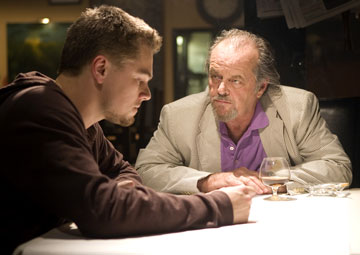
Vera Farmiga in The Departed
As Madolyn
Sometimes I wonder why it is that I like Vera Farmiga so much.- I have not seen her in much. Sure, she’s completely charismatic in interviews and such, but so are a number of actors that I don’t care for. I always remember Vera’s performance in The Departed with fondness. We first meet her with Colin the elevator. We sense her professionalism, but we don’t get much because it’s not until our second meeting with this woman that we really get to know her. We notice how she thinks in offhand statements, like on her date with Sullivan when he says. “You also do probation work, right? The bad guys.” I love Vera’s response, of “Not necessarily.” It’s not really that much ostensibly, but Madolyn is defined by her ethics. It’s like she says, “Sometimes, I want people to just forget about their personal bullshit and do their jobs.” It’s a bit ironic though when we take into account her subsequent meeting with Costigan. It’s easy for the audience to realise just how disconcerting it is for her to be flummoxed by a patient and as DiCaprio storms through the scene, Vera’s reaction is excellent. She’s reticent, but never overshadowed.
Of course Madolyn’s story, like the other characters, is capsized as the film continues. The call from Costello is obviously jarring to her. She’s smart, even smarter than we realise and as she observes Colin in the phone she knows things are more amiss than she’s letting on. The Departed never cares to condescend to giving the audience back stories, so we have to piece it together based on the excellence of the actors. Vera sells Madolyn’s attraction to Billy, though we see little of how it grew. It’s never tawdry (and not just because Costigan’s a “good guy”). She doesn’t get much leverage to end the relationship with Billy since it’s played out in just a short scene, but it always reminds me of the end of another extramarital affair. As the plot winds down she is given less to do, but I love when she finds out about Colin’s injudiciousness. Vera is good with her face and just her look of daggers to Colin is excellent. Our final shot of her is her look of anger at Colin. Sure The Departed doesn’t revolve around her, but Vera helps it to be brilliant.
               
What did you think of Vera in The Departed? Excellent, or overshadowed by the males? 
      

Thursday, March 18, 2010

Performances of the Decade (Male)

The general argument is that it’s difficult for actors to make a great impression on you in ensemble casts. Is it really? Brad, Ian, Ed and Tim all do excellent work playing supporting roles in large ensembles. I’m not certain if this is a supporting performance – I’d say no.
          
#5 Leonardo DiCaprio in The Departed (2006)
Sometimes I believe I can not the exact moment I knew Leo was on to something special in The Departed with Billy Costigan. It’s about twenty minutes in as he watches over the deathbed of his mother. He’s approached by his waspish uncle who gives the general affectations of guilt ridden relatives. Sure, Monaghan’s script is an absolute delight, but DiCaprio’s delivery that always floors me: 
“…Well maybe it would have done you some good to have a question from time to time. Am I an asshole, are my kids a mess? Is my wife a money grubbing whore? Those are questions. Have I ever been good to my dying sister or am I now just pretending to be?” 
It’s the sort of intensity that marks DiCaprio as an actor, and distinguishes Costigan from his peers in The Departed. From the first shot of him, his shifty eyed discomfort in the classroom in his police uniform which seems completely wrong for him. Or the first shot of him in civilian clothing as he waits outside Queenan’s office – there’s something a little off about this guy, we're not certain if he's bad or something bad has happened to him, but he's troubled.
The Departed is not a film that’s wholly concerned with defining each of its characters (the actors are left to their own devices), and even though on the most superficial of levels it’s the battle between good and evil it doesn’t care to relegate its characters to types either because although it would be remiss of us to call Billy a bad guy we can’t exactly call him a good guy either. One of the ironies of The Departed for me is that even though DiCaprio’s visits to Madolyn are part of the ruse he really does seem like someone who needs psychiatric help. His eccentricities do provide laughter, but it’s the sort of tense laughter that always makes you just a little uneasy. Who can forget the line about the cranberry juice? - The anti-diurectic drink. His outbursts in Madolyn's office are nice to watch, the implications below are unnerving. DiCaprio plays Billy with a deliberate stride, he’s not quite unhinged, but he’s on the path there. I’m never certain, though, if he’s acting in that first meeting with Madolyn or is he really is feeling that high-strung. I’m not sure he does either.
The thing is, though Leo convinces me of Billy’s craziness it’s the moments of uneasiness when he breaks down that are my favourite. The most piercing is the moment of Queenan’s death. It all happens so fast (it is a pity that we’re robbed of seeing more of Sheen’s excellent portrayal). That moment as Queenan’s blood spatters on Billy is taut and the pathetic expression on his face is intense. Queenan’s role as a surrogate father to Billy is obvious, as is the conflicting role of father that Costello should represents. The chemistry between DiCaprio and Nicholson is as effective as that between he and Sheen. It’s with the same intensity after Queenan’s death that he returns to Madolyn, the only person he can trust – even when he can’t. I can’t speak of Leo without at least mentioning Vera’s excellent work. She takes a character that exists principally as the plot point – and the role in theory is quite thankless – and turns it into a highly nuanced character. More importantly, Leo works well with her and the two do good work together.
Someone once said The Departed was one of those badass flicks, and it is. It doesn't care to sentimentalise and Scorsese demands the same from his actors. I suppose that The Departed still manages to work without DiCaprio but that doesn't make this performance any less of important as far as I'm concerned. His immersion in character is impressive even as he goes (unknowingly) to his death he is always Costigan, and no one else. A truly brilliant performance.
        
There’s a slight aversion to DiCaprio the actor that exists even if he tries to be as diverse as possible. I see this as the best work he’s done with Scorsese; but do you think it’s worth a mention?

Thursday, January 7, 2010

Clooney, Farmiga, Kendrick: All Up In the Air

Minor Spoilers Ahead
      
Jason Reiteman is a director I’ve always wanted to like. His debut Thank You For Smoking made my top ten of the year even though it was a flawed film, but I just could not be a fan of Juno regardless of what Ebert and thousands of others claimed. This season’s laurels have been thrown left and right at his Up In the Air – a film I was uncertain of going into it. The film centres on George Clooney’s Ryan, a man who hopes to attain ten million flyer miles whilst doing his job – firing people. He meets a female version of himself in Vera Farmiga while juggling with the new ingénue at his office played by Twilight star Anna Kendrick. This is Up In the Air.
                              
I wonder if I’m a flawed critic, but then again – who isn’t?. I didn’t think I’d like this going in. Clooney is not a draw for me and other than Farmiga I didn’t really love the whole idea of this film. Up In the Air is the perfect example of a film whose ostensible merits are lost on me. I didn’t expect to be blown away by Clooney’s performance, and I wasn’t. I know that George Clooney only plays George Clooney so I could let that ride, because that’s how it goes. However, I cannot discern even any attempt at layering the character like he attempted in Michael Clayton, which I didn’t like very much either. For the first three quarters of the film we’re led to believe that Ryan is the ultimate bachelor as he mitigates the point of marriage and children. Towards the end after an epiphany, which is altogether too artificial, he reaches out to the woman in his life, and fails. But I can’t care that he’s crush because I’ve seen no change in the character. His face looks sad, but there’s never that personal feeling. That's because Clooney doesn't even look like he's trying Ryan doesn’t really change and the subtlety that the role seems to call for is lost on Clooney.
But on to the women. I mentioned Farmiga was my biggest draw and I was disappointed. Certainly she’s the best thing in the film, but even as she creates Alex as this ultra snazzy and smart woman I can’t deny the fact that she’s obviously acting. It’s the same problem I had with Ellen Page’s Juno. I see an actress acting, and not a person. Mind you with Farmiga it’s better, but still not all there. It’s only until the second half that I distinguish any authentic life in the character and by then the film is so disinterested in her uniqueness that it’s all for naught. Certainly, I may be a bit harsh on her because I expected so much, but this is not as good a performance as she can do. I will admit that her final scene is better than any prior scene. But though it’s enough to make me forgive I can’t forget what went before.
                                          
However the most mind boggling element has to be the much lauded Ann Kendrick. I’m in the minority on this one, but I don’t care. Whereas Farmiga and Page were fair to good examples of actors acting, Kendrick doesn’t even do that much for me. It’s an example of a girl trying to act – and failing horribly. That breakdown scene in the airport still confounds me a day and a half later at its insanity Kendrick’s crying makes me cringe, and not from the reality of it – but from the ridiculousness of it all which strikes me as so contrived. Something is probably lost on me, but I really don’t understand how she has turned into the runner up [albeit a distant one] of the supporting race which actually has more to offer than Mo’Nique’s powerhouse turn. 
            
What exactly is it about Up In the Air that makes it a film of the times? Is it because it deals with unemployment? It’s not the first film that asks us to root for the hero who is actually quite despicable but Up In the Air doesn’t even seem to realise that Ryan is despicable. In Thank You For Smoking at least Eckhart knew he wasn’t perfect, that was the whole point of it. When Alex shows her colours I don't feel anything. Why should I? I've spent the entire film feeling that there was no value to this relationship, and Reiteman does nothing to make me rethink that. That pithy final montage of Ryan returning to his ways plays and we can feel Reiteman trying to pull at heart strings – but there’s nothing there to pull. And that scene with the unemployed just feels so peripheral and superfluous. Were we really supposed to be buying that BS Ryan was selling about the goodness of being fired?
         
Up In the Air works as a pleasant, if uninspired film, but above that I really can't feel like the rest of the population. It just leaves me, unmoved. Reiteman has done his least impressive piece for me here.
                       
C- [D+?]
    
Speak up. What are your thoughts on UP IN THE AIR?
Related Posts Plugin for WordPress, Blogger...