Showing posts with label March Bloodstones. Show all posts

Thursday, March 31, 2011

March Bloodstones: Mona Lisa Vito in My Cousin Vinny

I wasn’t certain how to end this semi-retrospective month on courageous cinematic woman. I wasn’t going for the typical Erin Brockoviches and Norma Raes (great courageous women, though) – and I decided I’d end up a lighter, but just as significant note. There really is nothing “courageous” about winning an Oscar – but I like to think that experiencing deep loathing by more than a few cinephiles for her “stolen” Oscar Marisa Tomei has managed to match the greatness of her first great performances once, twice and even thrice again. She’s a consummate supporting actress, and her scene stealing Mona Lisa Vito is a perfect encapsulation of the courageous female sidekick.
My Cousin Vinny is such a forgotten gem, one of those great nineties’ comedies that manages to retain its humour on multiple viewings. The fact that Mona is tagging along with Vinny for his foray into “real” always strikes me as evident as her tenacity. Marisa is so good at characterising her I can almost imagine a scene in New York where she’s doing another monologue at Vinny convincing him that she HAS to tag alone. She’s knows full well that he’s sort of an idiot, and she knows she’s smarter than he gives her credit for. She doesn’t care, though, she’s tagging along because she knows he needs her – complete with her scoffing glares at the town. I immediately love her from the line-reading “You’re famous for your mud?”
I feel a bit bad that my favourite scene of Marisa’s isn’t notable for her courage, but as soon as she starts talking about her biological clock in that outlandish, ferocious cat suit I cannot help but give her rapt attention.
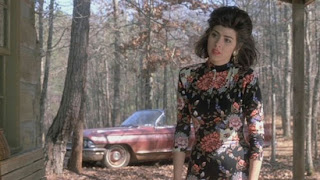
Marisa is a terribly physical actress (watch her brilliant final scene in Before the Devil Knows You’re Dead) and having her unconfined and able to pace around is a reason that scene always pops. It’s comedy, garish at times and even in broad strokes but she keeps on managing to retain that sincerity which is so elusive in pieces like this.
We’re never absolutely certain what she sees in Vinny, but the way that she defends him always impresses. Not only in the context of her being a supportive spouse, but as silly as he is Mona casts her bets on him, but more than she actively ensures that he’s able to be successful. She’s the type of supporting girlfriend who doesn’t get pithy moments of expressing love often, but in those rare softer scene she still retains her individuality and strength, most importantly she never “dumbs” herself down for him.


So, it’s as if we’re waiting for that brilliant cross-examination scene.
She’s so good with the rapid dialogue, and so brilliant against Pesci so as she literally shoots off the solution we think that even though the film is named for her man this movie is all about Mona Lisa....and that the thing about cinematic women of courage. When they appear on screen, it’s difficult to look at anyone else – least of all the men.
         
This marks the end of the Bloodstones of March who included:
Deanie Loomis in Splendor in the Grass
Margaret and Helen Schlegel in Howards End
Francine Evans in New York/New York
Shoshanna and Bridget von Hammersmark in Inglourious Basterds
Rita O’Grady, Lisa Hopkins and Barbara Castle in Made in Dagenham
Mona Lisa Vito in My Cousin Vinny
                
Am I the only one who loves Marisa's Mona Lisa?

Sunday, March 27, 2011

March Bloodstones: Rita O’Grady, Lisa Hopkins and Barbara Caste in Made in Dagenham

I never reviewed Made in Dagenham. I got a screener copy of it one literally one day after I wrapped up my 2010 Year-End Awards, which was a shame because it would have featured in more than a few of the categories. The movie is a simply produced biopic covering the fight for sex-equality in England, and which such a garishly “feminist” evidence of courageous women are obvious, but the good thing about Made in Dagenham is that despite it’s faults and its very prosaic plot it’s a whole lot more fun than you’d expect it to be.
Made in Dagenham reminds me most of movies like The Women or Stage Door - not because it’s a slice of classic life, but because in its wide foray of females I almost don’t want to single out any one of them as best in show. Almost. I’m both surprised and heartened that despite picking up zero awards’ tractions Rosamund Pike was being so constantly fêted as a potential spoiler in the supporting actress race way back when. To say that the role is paper thin might be a little too harsh. The thing is, the role manages to be paper thin and hopelessly predictable at the same time but Rosamund sells it. She’s always so good opposite fellow actresses (perfect opposite Keira and Carey) and truth be told – one of my favourite moments of the film is the throwaway moment in the car when Lisa and Rita both band together to bring down a chauvinistic teacher at their sons’ school. It reads as a bit insular that this “small” act is indicative of their female bravery...but whatever.

Not that Sally isn’t good herself, I was no big fan of her in Happy-Go-Lucky but she’s so charismatic here constantly besting the material she’s given. She’s sort of brilliant opposite everyone in her sedateness, in contrast to Miranda who finds her brilliance by being explosive. My appreciation for Miranda flip-flops. She seems to be having too much fun playing Barbara that sometimes you can just see her being over-the-top for its very own sake. She knows when to rein it in, though. What Barbara does for the cause is no small feat, and that moment where she has her way with her boorish assistants is brilliant.

I figure, my backhand compliments make it seem as if the trio are good despite overreaching issues in Made in Dagenham...and they are. The film has its issues, but it’s so sensible and confident I can’t help but forgive its simplicity. And then, these women are so infectious in their coruageousness, more often than not surprising you with their characterisations. How can I resist?
      
previously: Shoshanna and Bridget von Hammersmark in Inglourious BasterdsFrancine Evans in New York/New YorkDeanie Loomis in Splendor in the GrassHelen and Margaret Schlegel in Howards End
      
Were you a fan of Made in Dagenham?

Thursday, March 17, 2011

March Bloodstones: Shoshanna and Bridget von Hammersmark in Inglourious Basterds

Even if Tarantino does not make my heart sing, I feel it’d be a bit ridiculous for me to dedicate a month to brave women and not include at least one of his characters. For all his almost farcical gratuitousness I will always praise him for his sharp characters. For most, Landa emerges as the strongest attribute of Inglourious Basterds, and considering his many quotable lines – or Waltz’s performance – I wouldn’t say no. But he’s not who I remember first when I think of Tarantino’s World War II that wasn’t....

...neither is Mélanie Laurent’s Shoshanna, incidentally. For me, Inglourious Basterds begins and ends with the oft-forgotten Diane Kruger. Kruger appears, most noticeably, in the chapter 3 of the film I consider near-perfect (the film, not so much). I must confess that prior to BasterdsI had only the vaguest of notions as to who Kruger was and I’m most impressed at how effortlessly she exudes that sort of charm that takes years for the great ones, like Dietrich (who the role seems to be an obvious throwback to) to accrue. It’s that composedness in the face of constant unease that makes Bridget such an obvious candidate for courageous, and it’s – incidentally – what makes Shoshanna so interesting, too.
Laurent is occasionally exasperating for me with her expressions which occasionally seem to overly precise, or sometimes oddly vacant but I love Shoshanna in that strudel scene. There’s that uncanny feeling that Tarantino is too satisfied with his creations here – specifically Landa – but even then grandiose nature of it all doesn’t bog Laurent down there. It’s odd, that I find her Shoshanna most interesting when she does not demand our attention, almost menacingly as the scene draws to its close.
2009 was a fairly good year for supporting women for me. I think of my top three: Cotillard, Morton and Pike as one bloc, yet despite the fact that Moore and Cotillard (again) make up my top 5, others supporters like Mo’Nique, Mimi Kennedy, Penelope Cruz – but most of all Kruger, herself, always make me rethink my actual list of nominees. Tarantino is notorious for being ridiculous, but even when Inglourious Basterds seems to demand that absurdity Kruger maintains a composure that – unlike Shoshanna – doesn’t seem like more absurdity in the face of the already absurd. A fine example is the juxtaposition of the aloof Bridget with that wild shoot-out. When Shoshanna prepares for her end, her composure itself seems like some otherworldly incarnation of hysteria.
Yet, my occasional dissatisfaction with Laurent cannot mask the brilliance of the characters here. Both Shoshanna and Bridget meet their ends in moments that seem unworthy of their brilliance, although that – of course – is the way of Tarantino. The fact that that Shoshanna’s final act is more seismic than Bridget doesn’t undermine her courageousness. Conversely, Kruger’s superior performance doesn’t prevent Shoshanna from being a more interesting character to delve into. The film, perhaps, should feel more male-driven but there are two women at opposing ends. Both of them are, for the most part, well characterised, a sort of perfect encapsulation of female cinematic courageousness: Tarantino Style.
      
Shoshanna or Bridget? Diane or Mélanie? How courageous do you find Tarantino’s women in Inglourious Basterds?

Saturday, March 12, 2011

March Bloodstones: Francine Evans in New York/New York

This is another entry in my month-long retrospective on female centred cinematic bravery.
            
I hadn’t initially planned on taking a look at Liza Minnelli’s work under Scorsese, but noticing that her birthday was today I started thinking of her career. She’s both over appreciated and underappreciated. Most everyone recalls her brilliant 1972 Sally Bowles, but because of the raw deal that New York/New York often gets in history it’s not as oft-remembered. I remember I reviewed it on a whim for a LAMB’s Director’s Chair on the great Scorsese and it still doesn’t crack my top 5 Scorsese’s – although that doesn’t say much, I love most of his work.

New York/New York is a simple musical tale of love lost and then found – in New York, no doubt and it endures as one of Scorsese’s biggest “flops”. This time around I’m less interested in defending its merit, yet again. I’m more interested in Francine’s plight. New York/New York has one of those openings that exudes iconicity (even if it’s probably never endured as such) and a prolonged conversation at a club between Francine and Jimmy (DeNiro) is as much preparation for their characters as you need. This is five years after Minnelli’s tour-de-force in Cabaret and the performance is permeated with a high level of maturity that’s palpable. At the sake of being repetitious, I must declare that the way in which Liza suggests her mother here is poignant – haunting even, but Scorsese steps back just enough to prevent the exercise from being exploitative.
It’s terribly easy to read any bloodstone tendencies in Francine as evident in her struggle with abuse from Jimmy. She is an abused woman, but what separates Jimmy from the slew of spousal abuse dramas on a certain network is its focus on character not aspect, Francine is not just an abused woman and Jimmy is not just an abuser. But, even though screenwriter Rauch tries to balance the story it’s difficult for DeNiro to compete with Liza when she’s at her near best. Even if I’ll flip-flop as to whether this is her best work I remain convinced that it’s the role that encapsulates her talents best. For all her beauty and talent, there’s such a subtle awkwardness to Liza that makes her performances all the more golden. I love that first scene where Jimmy’s auditioning terribly and Francine decides to start singing. That naiveté of her there, oddly juxtaposed with her talent is such a great illustration of her; and oh, how the camera – Scorsese that is – loves her.

As broken relationships tend to go, Liza gets her token scene of bravery when the two part ways – the first time around. For all its intensity New York/New York is consistently funny (sort of the opposite side to Annie Hall from the year; a funny look at a doomed relationship that is humorous with moments of lucid dramatic awareness), and watching a pregnant Francine have the argument of all arguments with her husband in a cramped car on a busy New York street is just one of the thing that ensures that Scorsesian nature of this piece – and, incidentally, ensures that Liza gets all the chances to be brilliant. It’s only two scenes later that the narrative splits and Francine breaks out on her own, personally and figurative. We get a flash-forward that’s so subtly done (evocative of the flash-forwards in The Aviator, now that I think of it) that’s centred on her performance of “But the World Goes Round” – one of her richest performances, of the film and otherwise.
This is a musical, and music is Liza’s niche and of course she nails those musical numbers. It’s Ebb and Kander, so I feel no guilt in saying that this sits in the top 3 numbers that merges singing and acting – something that, so often, goes out of the window in musicals. It’s the second half where she gets all those iconic numbers though – like that legendary extended number “Happy Days” (a brilliant mini-movie in itself) and, of course, “New York/New York”. Her musical success is paralleled against Jimmy's and that bittersweet end where she “leaves” him for the second time never fails to pierce, because as dysfunctional a relationship it is – it’s still theirs. Yet, even though that ending should more weight for DeNiro, who is so piercing in that final scene. That look on Francine’s face when we realise the decision she’s going to make is beautiful. Oh Liza, so often praised...and yet, so often not...
                 
Happy birthday, Liza.
             

Wednesday, March 9, 2011

March Bloodstones: Helen and Margaret Schlegel in Howards End

The bloodstone is the stone of March, and March is women's history month. Hence this post, (first entry HERE).
                 
Jhabvala and Ivory don’t have the comfort of Forster’s lush narrative to wallow in, so they’re prevented from establishing – immediately – the radical ways of the Schlegel sisters, and yet from that very first visit Mr. Bast pays to their flats one is swayed to believe that there’s something peculiar about them. There’s already something eccentric in the on-and-off engagement between Helen and Paul and as Mr. Bast raps at the door – to retrieve his stolen umbrella – there’s something even odder about Margaret’s, “Not again, Helen. She is an incorrigible thief.” It’s not exactly courage, as yet, but it’s an essential bit about organic everything in Howards Ends unfolds – it’s never uncinematic but it always retains a definite literariness.
 
Helen seems like the more obvious candidate, but the quietness with which Margaret approaches her tentative relationship with Mrs. Wilcox seems decidedly gracious in its way. It’s the sort of selfless nobleness that we come to define her character by, and though it’s pointless to see the character through any sort of feministic lens it’s notable that both she and Helen define their bravery in relation to the men about them. But, I’m getting ahead of myself. Again I come to this quandary of defining courage, and like Deanie Loomis (but, perhaps, not so difficultly) finding overt acts of courage is rare. Yet, the fact that they’re so erudite and well-meaning, even in their middle-class naïveté. The Edwardian era isn’t as symbolic as repressed women as, say, the Victorian era but considering how the upper-class Mrs. Wilcox feels about women’s education I can’t help but feel some commendation is worthy of them – although Aunt Jules’ aside “…but their father was German, and that is why they care for literature and art” seems (like everything about her character) superfluous and ridiculous.
Because it’s the moment where the two storylines finally interact, the wedding emerges as that obvious moment for watching different types of “courage”. Taking Forster and putting him to screen seems to be such a dubious task, and I have added admiration that Helena Bonham Carter manages to toe that line between histrionic and passionate so finely. The same goes for Thompson, in opposite form; even when Margaret is at her most dubious it’s difficult not to identify with her. True, her knee-jerk embarrassment to Helen’s theatrics seems to subvert any significant act of courage and if you’re sinister and think that if, perhaps, Helen’s pleas for equality (for the Basts) is driven by romantic inclinations then it does the same. Still, as much as the narrative (and in lieu, the film) have that utilitarian function of showing us a “new” England the nice thing about Howards End is how complex the characters.
I hate to think of it as some sort of misguided penance, but it’s to Helen’s credit that she bears her pregnancy alone – even if there’s something vaguely repressive about her intended plan to spend the duration of her pregnancy. For all her excitability, Helen is defined by childishness where Margaret – as the older one – emerges as, arguably, the braver of the two. Emma is a powerhouse opposite Antony towards the end as she prepares to leave him, and it’d be an injustice to her (Forster, Jhabvala, Ivory and the film) to see her reneging of that decision as evidence of her lack of courage. It’s the very thing that defines Margaret, her gentle grace in spite of the obvious and there’s that looming sense of justice as the camera pans over to Helen and her child and Margaret and Henry walking the plains. Howards End is not a women’s novel (thematically, or audience wise) but Forster’s characters and the interpretations of Thompson and Bonham Carter are fine evidence of courageous women – their excessive chatter is confirmation.
                       
As Mr. Bast says, “The more a lady has to say, the better. Ladies brighten every conversation.”

Tuesday, March 1, 2011

March’s Bloodstones: Wilma Dean Loomis in Splendor in the Grass

March the 8th marks International Women’s Day and most of you US citizens probably know of the month as Women’s History Month. I’m not American, but I still like the idea of March being the month of the woman, moreover when I think that its birthstones are aquamarine and bloodstones – gems signifying courage, and March was named after Mars – the god of War. It’s an interesting task, trying to discern courageous women in cinema – regardless of how many claim that there’s a dearth of female roles available, there’s a gamut of courageous women you could think of.
As I said, courage is a strange thing and you don’t immediately identify Natalie Wood’s brilliant Deanie with the typical encapsulations of female “hear-me-roar” courage on screen, she’s hardly combative. In fact, if you glance at the plot – a girl seemingly runs crazy after having sex – it sounds decidedly misogynistic and uncourageous. I like to think of Splendor in the Grass in the same way that I’d think of a William Blake poem – ostensibly supporting what seems like so messed up morals, while all the while actually subverting. The attitudes of women are an important part of William Inge’s screenplay. There’s that scene I love where Deanie and her mother are talking about sex and she says,
“Your father never laid a hand on me until we were married. Then I... I just gave in because a wife has to. A woman doesn't enjoy those things the way a man does. She just lets her husband come near her in order to have children. ”. 
It’s an unintentionally hilarious (but conversely, terribly disturbing line) and it makes the morals on which Splendor in the Grass is built seem sort of dated. But, for all its datedness the way that Inge and Kazan examine the age old theme of gender relations is quite interesting.
Like, Bud’s (Warren Beatty’s brilliant debut) sister – played to beautiful, albeit hammy, perfection by Barbara Loden. The film suggests, but never ascertains, that this is what the future holds for Deanie if she refuses to wise up and accept her role in life. Of course, that’s not really true – because, for all the madness that she endures she still emerges with a semblance of grace at the film’s end. And, it's not really madness that she undergoes in reality. I call it Natalie at her best, because she so often avoids the most obvious ways of making Deanie ridiculously crazy. Which takes me to the other important William of the film – Wordsworth. It is his poem that gives the film’s its name. It’s probably wrong to read too much feminism – if any at all – in Splendor in the Grass, but there’s something decidedly close to liberalness in that final shot watching Deanie drive away.
Natalie Wood has an inherent “superior” nature to her, that’s not quite condescending but still a little lofty (perfect example: the entire last half hour of Love with the Proper Stranger). And the look on her face as Deanie meets Bud for the last time is striking on so many levels. Not only because Bud looks like the guy who killed the goose that laid the golden egg, but that easily discernable look on Deanie’s face as she things that she could have had this life with him, then accepting that she doesn’t and then a sort of elation (in Natalie’s own subtle way) that she doesn’t. One isn’t naturally inclined to identify surviving with being courageous, but I like to think of Deanie as more than just a little courageous. And how can you not love Natalie in her greatest performance?
        
Is Deanie an appropriate start to courageous cinematic women?
Related Posts Plugin for WordPress, Blogger...