Showing posts with label The Philadelphia Story. Show all posts

Monday, May 23, 2011

Encore’s Birthday Marathon: Day 6

It's all about Cukor today in another string of random vignettes of movie memories coming from yours truly as I count down the days to my birthday.
  
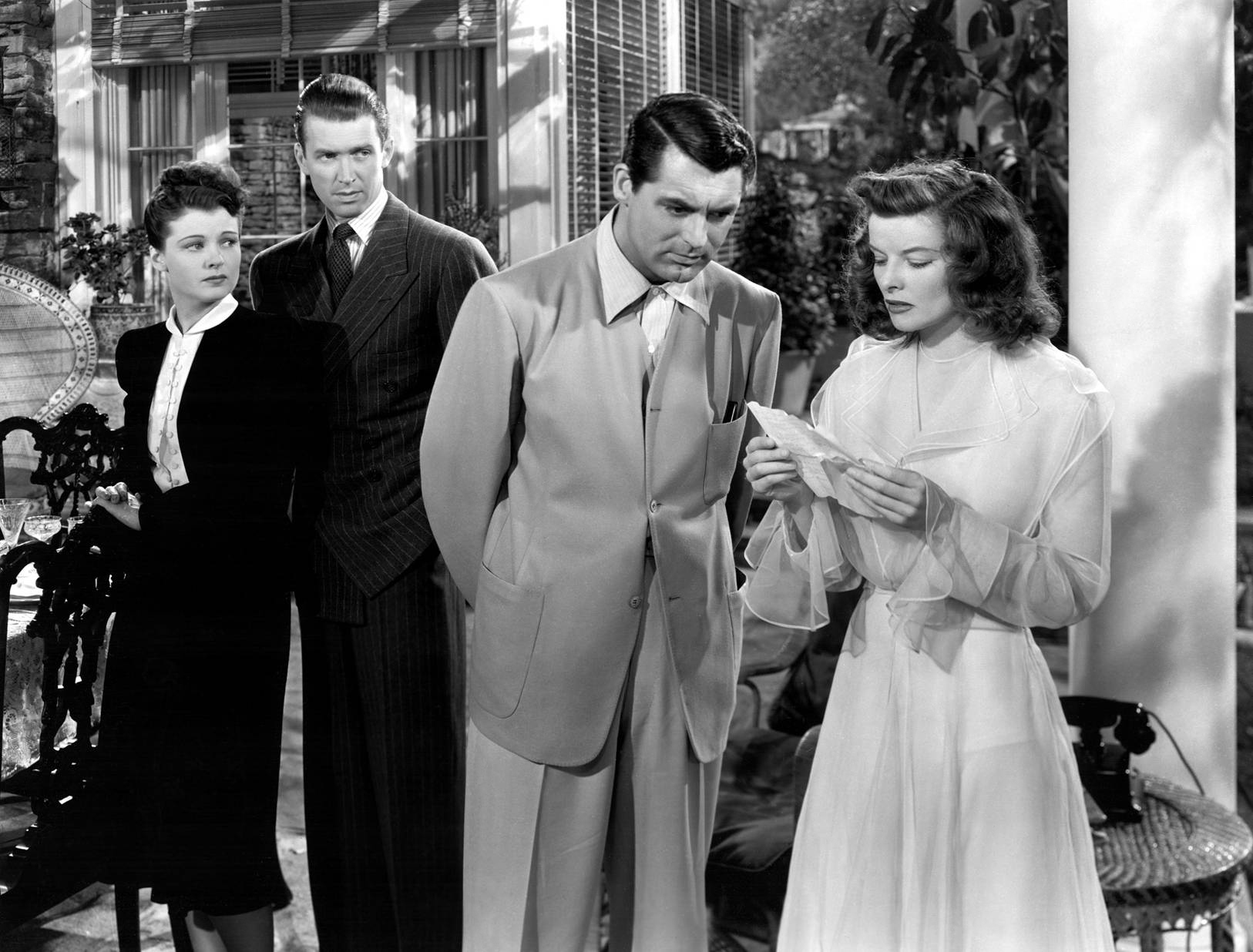
The placement is all random, really, but I can’t have a movie blogging marathon without paying some sort of tribute to the brilliance that is George Cukor. I happened to re-watch The Philadelphia Story this past weekend. Truth be told, I’ve probably rewatched that one more times than I needed to – it’s a great option for relieving stress and it’s that same lightness in tone which George Cukor is usually remembered for. That’s a disservice to Cukor right there, though, by fĂȘting this lone title of his eschewing all the other great work that he’s done.
           
I am vicariously offended, on his Cukor’s behalf, because he does not have as estimable a reputation as most of his peers. I’ll admit that in terms of being prolific William Wyler is probably at the zenith of pre-60 directors but when it comes to actually quality I’m firmly in the camp of Cukor and Kazan. Kazan gets shafted because of that “naming of names” scandal and Cukor gets shafted because he’s a woman’s director. The thing is, I’m still not sure what precisely comprises a woman’s director. I immediately recall that revelatory post Jose did after the Academy awards’ where he pointed out one of Oscar’s more disturbing trends and I suppose a “woman’s” director is one who focuses on women’s issues. If that’s what constitutes the term, there’s no shame in such a director but it seems silly to relegate Cukor’s work to just that, still. I’d be more inclined to call him a director who focuses on societal issues, not women specifically.
   
In terms of superficial longevity most probably remember Cukor for My Fair Lady. Incidentally, as big a fan of Cukor as I am I’m not especially fond of My Fair Lady (admittedly, I’m biased against Rex Harrison as it is). Even if I didn’t have that bias, I’m sure I’d be hard-pressed to find anyone who’d call it Cukor’s apex. Of course, that’s just the typical Oscar fashion where the best and the rewarded are not always immediately reconcilable.

My first immediate interest in Cukor was, of course, instigated by Katharine Hepburn. She devotes a number of pages to him in her biography and together they’ve done some brilliant pieces. For me the trio of The Philadelphia Story, Adam's Rub and Little Women is most prominent. It took me some time to warm up to Holiday (I’m not a fan of Barrie’s play) but those three are the height of that comedic cadence he does so well, which is buoyed by an interest in more serious issues. Still, Cukor’s talent isn’t even consigned that trinity. Just watch how he moves from breakneck pace hilarity with Tracy Lords and C. K. Dexter Haven to claustrophobic tension with Gregory Anton and Paula Alquist. There are some scenes in Gaslight that might even recall some of Hitchcock’s work. It’s an obtrusively far cry from the lighter fare that immediately comes to mind when his name is mentioned. Then, measure that against the poignant melodrama of A Star is Born or the tenacity (occasionally mired by confusion in Wild is the Wind). The man is diverse.

And yet, so many have supreme tunnel vision when it comes to him. If there’s any one thing which Cukor maintains as he switches from genre to genre it’s that delightful bit of irreverence with which he marks his films. That’s probably the reason why Sylvia Scarlett seems so bathetic. It’s arbitrarily rewarding, but its strangeness is probably a bit too garish for the fainthearted. Still, I love Cukor – on his good days and his bad days, he always has something to say.
What I’ve Seen of Him
Adam's Rib A/A-
A Bill of Divorcement B
Born Yesterday B+
Holiday B+
Gaslight A-
Pat & Mike B/B+
The Philadelphia Story A
A Star is Born A-
Sylvia Scarlett B
My Fair Lady B/B+
What Price Hollywood? B
Wild is the Wind B
The Women B+
         
Is there any love lost between you and Cukor?

Thursday, May 19, 2011

Links Fell Down

Yeah, I had a link post recently but more is always more and there are some more posts that have been quite interesting. This review of Ric's for example of The Social Network is quite perceptive.
    
 The Mad Hatter has a question for you. Which DVD’s do you own that you never watch? I actually have a number of extraneous DVDs, I should probably get rid of them, but I’m a hoarder.

Remember Being Julia? I’m a big fan of it, it has its issues but it’s much wittier than you’d anticipate and Bening is just phenomenal in it. It’s a short review, but Yojimbo points out some astute points of it.

I linked to CS’ last smackdown between Scarlett and Natalie but I find this one even more interesting (even if it’s easier to judge). He asks us to choose between Spielberg and Scorsese. You know who’s camp I’m in, but I sure would like to know what you think.

I love this post from Tom on Next to Normal. No, I haven’t been lucky enough to see it, but I do love the cast recording – the music is PHENOMENAL!!!!

and to close, Peter Bogandovich (yes, THE Peter Bogandovich) offers up an excellent look at one of the issues with The Philadelphia Story. Now, you know how much I love the Hepburn/Grant/Stewart flick but I will admit that the points are excellent.

Tuesday, January 18, 2011

Cary's confused, it's his birthday today and no one seems interested. Don't worry, we haven't forgotten you C. K. Dexter Haven. You're still my favourite drunken ex-husband.
                    
Happy birthday.

Tuesday, August 24, 2010

Movie Meme, Day 24: Quotable Quotes

I'm feeling ridiculously tired at the moment, and really the possibilites are endless (I sense a series of post imminent on this topic). Nonetheless, the ones that came to mind first...
        
Beautiful Profundity
The English Patient: “Betrayals during war are childlike compared to betrayals during peace. New lovers are warm and tender, but smash everything…for the heart is an organ of fire.”
The Lion in Winter: “Of course he has a knife, he always has a knife, we all have knives! It's 1183 and we're barbarians! How clear we make it. Oh, my piglets, we are the origins of war: not history's forces, nor the times, nor justice, nor the lack of it, nor causes, nor religions, nor ideas, nor kinds of government, nor any other thing. We are the killers. We breed wars. We carry it like syphilis inside. Dead bodies rot in field and stream because the living ones are rotten. For the love of God, can't we love one another just a little - that's how peace begins. We have so much to love each other for. We have such possibilities, my children. We could change the world.”

Brilliant One-Liners
The Philadelphia Story: “This is the Voice of Doom calling. Your days are numbered, to the seventh son of the seventh son.” 
           
The Big Chill: “I don't know anyone who could get through the day without two or three juicy rationalizations. They're more important than sex.”
        
Gosford Park: “I'm the perfect servant; I have no life.”

Useable in Everyday Life
There’s a scene in The English Patient when Ralph Fiennes’ patient turns to Juliette Binoche’s Nurse – Hana. “Did you know Herodotus is the father of all history.” She responds glibly, “I don’t know anything.” The line itself is nothing of brilliance, but Binoche’s line reading has stuck with me since…I use it quite often with the same inflection. It's true.
       
All for the MEME.

Thursday, August 19, 2010

Movie Meme, Day 19: Best Movie Cast

This was such an odd question for me. Obviously best cast is not synonymous with best film, but the overlap is hard to avoid even when I think that it doesn’t always end up being there. Only a few days ago I waxed on (with the help of others) about the all around brilliance of The Philadelphia Story and really that comes to mind as the strongest cast I can think of. True, other than the four principals (Hepburn, Grant, Stewart, Hussey) the cast is filled with less-popular folks but what makes The Philadelphia Story cast so brilliant is the fact that big names aren’t necessary to make it so. Any scene in the film sizzles, regardless of if the big names take centre stage.
Another film I mentioned in my top ten, Gosford Park would be a worthy candidate for best ensemble. From Helene Mirren to Michael Gambon to Maggie Smith to Clive Owen to Kristin Scott Thomas to Emily Watson and on and on and on, it’s just too brilliant for words. Is it not obvious why I’m always fawning over Altman’s masterpiece? It’s the way of the Britons, though, consider Howards End another film peppered with the English that’s just fantastic when they all come together.
Still, the small casts don’t get enough credit – look at Who’s Afraid of Virginia Woolf – only four greats in Taylor, Dennis, Burton and Segal – and they do all the heavy lifting brilliantly. A Streetcar Named Desire has more than four but it all comes down to Stanley, Brando, Leigh and Malden and they work brilliantly together. I don’t love the play or the film for Long Day’s Journey Into Night – but I dare anyone to not be floored by the collective brilliance of Katharine Hepburn, Dean Stockwell, Ralph Richardson and Jason Robards in Lumet’s oft forgotten film.
The eclectic casting in All About Eve is worthy of remembrance too. Every one, not just Bette, turns in brilliant performances even if it’s all about the women at the end of the day…a bit like Woody Allen’s Bullets Over Broadway, the men are smashing but it’s the women who take the cake at the end of the day.
I often think of Shakespeare as being the perfect playwright for ensembles and it makes sense that it’s a Shakespeare piece that I first though of. I wouldn’t call it the best ensemble – anyone I’ve mentioned thus far could take the cake, but I can’t be the only one who thinks that the ensemble of Shakespeare in Love is something to applaud heartily. Its best picture victory remains as one of the Academy’s most lucid decisions in the nineties and there’s no doubt that the ensemble is one to treasure.
           
Film is good, but there’s something particularly great about seeing a group of actors – big or small – work cohesively. There are dozens more I can think of, but these nine take precedence...and this is all for the MEME.

Saturday, August 14, 2010

“My, It Was Yare”

I’m not a demanding movie watcher, so I don’t insist that my movies immediately begin in some eccentric manner. Nevertheless, I’m always pleased when a beginning is particularly solid and off the top of my head the opening of The Philadelphia Story is definitely somewhere in my top 3 favourite openings. It’s as concise, simple and funny as some films throughout and all without a single word being uttered. Cary Grant comes out of a house, ostensibly dressed for work with his briefcase in hand. Katharine Hepburn comes out soon after – the devoted wife, perhaps? She carries his golf clubs to him, and after a moment’s hesitation breaks it over her knees and saunters back to the door, followed by Cary who with just the slightest pause takes his hand and – with an open palm, mind you – proceeds to sock her. That’s just the beginning, just the beginning….
You can’t help but get nostalgic when you watch The Philadelphia Story; hell, I wasn’t alive in the forties but the mood evoked is so “classic” we have no choice. I’m sounding incoherent; Jose of the kick-ass Movies Kick Ass tells it better:
“They say that the movies you love grow old with you. When I saw The Philadelphia Story for the first time I was a kid who was falling in love with the movies; therefore, George Cukor’s elegant take on the screwball comedy seduced me in the most unexpected ways. I couldn’t believe people as beautiful as Kate Hepburn, Cary Grant and James Stewart could also be “earthly” and feel accessible in the way your wildest dreams can’t help but feel real when you wake up. A few years later as a socially conscious teenager I couldn’t help but admire the smart way in which the screenplay addresses the irregularities of class difference and the term “intellectual snob” became a pet cause of mine.
In that way the movie has gone from being a stress reliever to a handbook in how to handle society parties, a cruel essay about the human heart and a lesson in how to dress for every occasion. Just yesterday as I watched it again it became something new to me; for the first time I identified myself with Tracy Lord and her quest to become a human being. I couldn’t believe that a movie I’d seen countless times before was addressing something I’ve just discovered about myself. I’m honestly thrilled to discover what it tells to me the next time.”
I do love that evaluation on it. It’s one of the great things aboutThe Philadelphia Story. There’s so much going on in it that watching again doesn’t dilute its inherent brilliance. The Philadelphia Story is easily the best comedy I’ve seen, and perhaps will ever see, it is smart and yet silly and for all the serious issues addressed it’s not afraid to be self-deprecating either.
     
I’m always interested when plays are adapted to screen. It’s anyone’s guess how it will turn out. Will it be as “judicious” as Who’s Afraid of Virginia Woolf or Closer? – Or will it be more adventurous – a Cabaret or Cat On A Hot Tin Roof? After all – the stage is not the cinema and in adapting The Philadelphia Story Donald Ogden Stewart seems acutely aware of that. The Philadelphia Story is driven by words, and yet the characters are never relegated to talking heads even with a story that could seem convoluted to the careless viewer. Tracy is getting married to George (a nouveau riche) after divorcing a C. K. Dexter Haven (old money). Tracy’s father is shacking up with some flamenco dancer of sorts and a newspaper is editor is intent on highlighting the scandal; something the affable (yet despicable) Haven is keen on stopping. Enter reporter Mike Conner and his photographer – a Ms. Imbrie. And we haven’t even touched on Tracy’s family yet – her precocious sister, her imprudent Uncle Willie and her careless mother. It’s enough to make even the most confident screenwriter balk, yet Stewart handles it brilliantly, since The Philadelphia Story – above all else, is an actors’ showcase.
My bilingual friend from Oxford, Anahita of My Life In Film (currently on vacation) is smitten with this oldie too.

“For me, the highlight of The Philadelphia story has to be its strong cast and incredibly witty script (OK, so cast and script are usually the two most important. Still. It goes doubly for this film. Stay with me). Cast-wise – there is just utter perfection. Jimmy Stewart – one of my favourite actors – utterly shines as newspaper reporter Mike Connor, he has perfect comic timing – even making Cary Grant laugh by accident in the scene where he is utterly drunk – yet shows also a great deal of heart and sweetness, making his character a wonderful blend of sharp humour and kindness. Cary Grant is also fabulous as the ex-husband, his one-liners and answering-backs are just hilarious, especially when he plays off Virginia Weidler’s Dinah Lord, showing him just to be a big child, albeit again one who has a soft side, namely his love for Tracy (Hepburn). And speaking of, Katharine Hepburn as always is sublime – among the best two actors of the time (yes they are. Don’t argue) it would have been so easy to get lost and fade into the background, especially as a woman at the time, yet she holds her own, and creates a memorable character out of Tracy Lord. The script is peppered with funny moments – so original, sharp and witty that it’s just mind-blowing who thought of all of this hilarity – and the actors push it even further into perfection. I just love it.”
Yes, those quotable quotes. I could rattle them all off, but there’s so many. The eternal question is asked, who is the best in show? The best in show is whoever’s speaking at the moment.
A favourite scene of mine (and there are many) occurs when Mike and Liz first meet Tracy. Not the real Tracy, but the fabricated one she keeps for the press. As she laments in an affected French accent and saunters around in deplorable fashion I could only imagine Katharine Hepburn laughing her head off inside. Phillip Barry did fashion Tracy after the first lady of cinema. Consider this with another side of Tracy – which we can’t really call the “real” Tracy either. It’s probably the film’s most iconic scene. As Mike and she drunkenly wander about the pool the romanticism of it all is intoxicating. It’s the best I’ve seen Kate (pre-1950) and the best I’ve seen Jimmy Stewart. Everyone’s on their game in The Philadelphia Story, but there’s something especial about the scenes those two share together. They do make a good couple. Yet, it’s a testimony to the two that the scene never feels like too much. Call me a blasphemer, but I prefer these moments with Stewart to the moments with Grant – which are excellent, nevertheless. It actually took me multiple viewings to realise subtle moments of intelligence in the film. As lovely as they seem to exist together, it’s obvious that Tracy and Mike are too similar. Both are too unforgiving of the world around them, and it’s up to Liz and C. K to “whip them into shape” – humanise those intellectual snobs. And the reunion with C. K. Dexter Haven is just right, it is as witty and well played as anything we’d have on screen today. Scratch that – more witty, and probably better played too.
The thing about it is that the entire of The Philadelphia Story feels like so much fun. I always remark that Ocean’s Eleven (and Twelve) was proof that a cast of good actors were willing to come together and have fun and though The Philadelphia Story’s cast is not as extensive it does it even better. It’s the sort of film where you want each cast member to be singled out for their contribution. Like Virginia Weidler’s intelligent Dinah. Preciousness in children on screen is a dime a dozen but Virginia Weidler still manages to be particularly inviting without falling into the usual traps (the newspapers were full of “innundo”), Roland Young’s Uncle Willie is a source of some throwaway humour and no one plays better off these moments than Ruth Hussey. I’m almost a bit miffed when persons don’t appreciate her as they ought. Her comedic prowess is in opposition to Kate’s and it works so well in the grand scheme. Her Liz is the source of constant delight as she refuses to be a fourth wheel to the unholy trinity of Grant/Hepburn/Stewart. And they really are an exceptional trinity aren’t they? I have no problems with Stewart’s win; he even manages to outdo Grant who I will admit should have earned a nomination, though. And the marvellous Kate…what’s to say that hasn’t already been uttered? She’s absolutely perfect. – And then some. Luke of Journalistic Skepticism continues on sharing the love for The Philadelphia Story.

“Headlined by one of the greatest casts ever assembled, The Philadelphia Story is a truly perfect comedy. The cast chemistry is through the roof from Katharine Hepburn’s entitled socialite Tracy Lords to Jimmy Stewart’s impeccable performance as reporter Macaulay Connors to Ruth Hussey’s droll take on Liz, Connors’ devoted photographer. It’s a virtual smorgasbord of zany antics paired with New English society banter – a match made in 1940s heaven.”
        
Yet, I really can’t ignore some of my issues with The Philadelphia Story when I get retrospective. Why must George be relegated to almost villainous proportions at the film’s end? Simply because he’s the only one not comfortable with the class he was born into and wishing to be upwardly mobile? And why must Tracy be punished for her father’s indiscretions? That arc of the film never fails to exasperate me…And it gets funnier – why does Tracy choose Liz as her last minute matron-of-honour? Wouldn’t she have had one for the wedding that already supposed to be in progress? But when I tell you that I don’t care, you can understand just how much I love this movie. Right? It is #4 on my list of favourites…and my favourite Kate flick… and because I’m too lazy to MEME today I’ll just mention that this is my favourite black-and-white film.

Thursday, April 22, 2010

"All In A Day's Work"

Entertainment Weekly is always up and about making lists, and I always end up having severe issues with them. Their most recent is one on the best films that occur within 24 hours. They've got some fine choices there (Ferris Bueller's Day Off, America Graffiti) but they really missed the ball on some rather obvious choices. So, I've done my duty to make my own list - my top 5 films that occur in a day. I'm not ranking them on merit, but on how well they incorporate the one day theme...


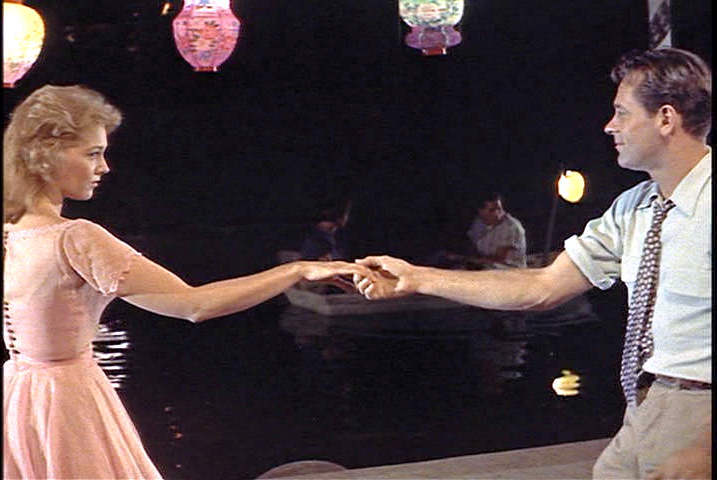
#5 - Picnic (my review)
I don't particularly grudge them for not including this on the list, it's not really a popular film. Still, it's a favourite of mine somewhat. In Picnic Hal (played by William Holden) - a good-looking good-for-nothing shows up on the day of their Labour Day Picnic and rocks the town. It's based on the Pulitzer Prize winning play by William Inge and features an ensemble cast with Kim Novak and Rosalind Russell. I suppose Picnic can get a little sentimental at times, but that's part of its appeal I think.
         
#4 - The Philadelphia Story (musings on Kate)
I suppose this doesn't really happen in a day, which could explain why this classic piece is missing from the list. It begins with a prologue and then flashes forward to the morning before Tracy Lord's (Katharine Hepburn) wedding. As the day unfolds she's torn between her fiancee, her ex-husband (Cary Grant) and a newsreporter (James Stewart). After a night of craziness she comes to the right decision in the morning. The film doesn't happen in a day, but it happens in 24 hours - so I say it's eligible. And this one's based on a play too...
             
#3 - Cat On A Hot Tin Roof (my review)

Trust Entertainment Weekly to ignore Liz Taylor at her sexiest. In a nutshell, it's about a woman who's trying to convince her husband to sleep with her while her father-in-law may (or may not) be dying and the vultures are gathering around in anticipation the will. It's a depressing film, but Tenneessee Williams excellent writing makes it very accessible and Taylor and Newman give some scintillating performances. Classic...and based on a classic piece of literature too.
     
#2 - Guess Who's Coming To Dinner? (my review)
It almost topped the list, and with good reason. It has its haters, but this film really makes excellent use of the one day plot point. Mr and Mrs Drayton (Katharine Hepburn and Spencer Tracy) are a white couple who love all races, but they're still somewhat surprised when their daughter Joey (Katherine Houghton) brings home a black man 14 years her senior hoping to get their blessings. The conondrum is that Dr. Prenticehas to leave tonight, so time is of the essence. Guess Who's Coming to Dinner isn't exactly perfection, but it is enjoyable, smart and classic.
        
#1 - Who's Afraid of Virginia Woolf? (my review)
 
What an egregious snub. This film doesn't utilise the full 24 hour, it doesn't even use twelve. This one's based on a play too, incidentally. Martha and George are two sadists (Richard Burton and Liz Taylor). He's a college professor, she's his wife and the daughter of the dean. They may, or may not, have a child. They invite the new young professor and his wife (George Segal and Sandy Dennis) for a night of fun and games. We get games, but not so much fun. After seeing this you'll probably want to stay away from marriage and from liquor, I know I did.
                     

What have we learnt? Entertainment Weekly needs to get better list makers, I like way too many classics, and plays are the best source material for film. All in day's work.
Related Posts Plugin for WordPress, Blogger...