Showing posts with label O'Toole. Show all posts

Friday, March 25, 2011

To David Lean...

I'm having computer troubles at the moment, which is just ghastly. I had so many articles to finish completing, but it is what it is. I'm too lazy now to finish the actual article I'd planned on doing for David Lean. It's difficult to avoid Lean's more overt characteristics of being a prelude to Anthony Minghella (whom I adore). I always feel just a bit bad for not loving Lean indiscriminately, though I do love him on occasion. Not that he needs absolution from me, the man has two Oscars. I'm still not certain about how I feel about The Bridge on the River Kwai (though I think it was the best of the nominated five - not having seen Sayanora), but the one for Lawrence of Arabia is more than deserved. It's a shame he won his Oscars for the films devoid of female emotion since I think he does so well when he takes a look at them (Summertime, A Passage to India even Brief Encounter or Doctor Zhivago)....but, we know about Oscar/Best Picture and Women.
               
His trump card will always be his attention to detail. His directors of photography almost always did brilliant work; just look at that beautiful shot from Doctor Zhivago below.
I didn't even know he worked as his own editor on A Passage to India. I still haven't seen either of his Dickens adaptations or a few others of his significant ones, but I love these three the best - and these three performances, each of them so very timeless. Yes, I'd have Oscar-ed them all.
Ultimately, I'd remember David by heading back to Summertime - it's unnaturally low-key for him, but I think it's remarkable (and he reportedly loved it most of his films). How would you celebrate his birthday?

Monday, July 19, 2010

“What Family Doesn’t Have Their Ups and Downs?”

“What is truth in art? What is truth in cinema? If by truth you look for accuracy and period detail then The Lion in Winter will not be for you. If, on the other hand, you look for that deeper truth of the Human Condition then few films get closer to identifying it. Writer James Goldman takes a warring family with 20th century feelings and responses and places it firmly into the context 12th century royal politics. It’s an extraordinary achievement aided by a superb cast (Hepburn, O’Toole, Hopkins all at the top of their game), convincingly low key design and a terrific quasi-monastic score.”
Ben, of the irreverently named Runs Like A Gay wrote the above. He’s actually been lucky enough to take part in a production of the excellent play and I couldn’t agree more with his summation. As far as history dramas go The Lion in Winter may be little more than farce, but if it’s farce – it’s irresistible farce.
“What a desolation!”
               

Were one to line up the reasons – rationally as possible – as to the pros and cons of Anthony Harvey’s 1968 drama, the sound question one would be moved to ask is how the film managed to be a success. The fact is, The Lion in Winter has more going against it that for it. First off, it’s a historical drama. It’s nowhere near as expansive (thematically) as A Man For All Seasons and this Henry isn’t the one that most history buffs are interested in. Secondly, in the mere few days the film covers nothing particularly pertinent happens. In fact, were we moved to ask what any particular character has accomplished during the film’s runtime we may end up answering – nothing. And conversely, while the action is sparse the film is very “talk-y”, not exactly a prerequisite for a good (or enjoyable) film about the 12th century. Yet, The Lion in Winter defies these odds. The original stage production wasn’t much to shout about (or so I heard), but perhaps it’s the inclusion of our Lady Kate, Peter O’Toole and a newly discovered Anthony Hopkins that makes it such a success. Perhaps, the story was just more suited for the film. I don’t know. Whatever it is, I always marvel at it.
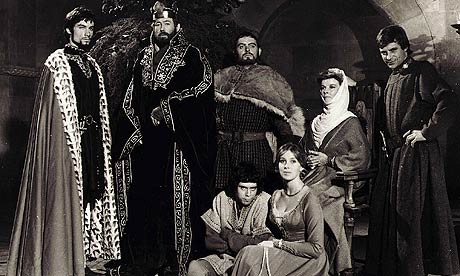
It’s some time during the 12th century and Henry is on the throne. His wife, Eleanor of Aquitaine, is imprisoned in Salisbury Tower. Henry has three sons (on screen; historically there were more) and he’s uncertain whom should be his successor. There’s the lion hearted Richard, the duplicitous but sage Geoffrey and the petulant John. It’s Christmas, though, and thus the family reunites for a few days. Unfortunately, festivity is low as Prince Philip is coming to Chignon to demand that this sister be married to the heir of the throne (whomever that may be) or returned to France. Princess Alais has been in England for some time, now acting as a concubine to the King – but a marriage, to anyone, seems dubious. Thus lies the state of affairs as The Lion in Winter opens. It would be a thorny task to say what happens within the next 120 minutes, and I don’t think I’d care to explain either. Lies will be told, games will be played, knives will be drawn (as will curtains, too), persons will be duped and of course it ends with goodbyes (yet, curiously, no tears). From the inception, the atmosphere of it all is striking. Look at the earlier incarnation of Henry’s life (the 1964 Becket). This set is not the same. Unlike its predecessors the courts of this incarnation are not spotless, but soiled and unkempt – like we’d expect from the period. The Queen’s robes are majestic, but not unblemished and unlike the 1964 piece the court is pervaded by the presence of animals – domestic and otherwise. It’s not the typical period piece, and it shows.
Tom of the eclectic Reinvention: The Journal of a Dog Lover, Book Reader, Movie Goer and Writer shares his thoughts on the film.
“At the heart of this deliciously medieval drama is Katharine Hepburn as Eleanor of Aquitaine, imprisoned queen of tempestuous Henry II (the roaring Peter O'Toole). This is the consummate portrayal by one of cinema's most brilliant actresses. Hepburn demonstrates a stunning ability to speak volumes with a word, a look, a tremble of emotion. In a single scene, sometimes with a single line of dialog, she goes from beautiful and vulnerable to ironic and witty to cunning and calculating.

Director Anthony Harvey and Screenwriter James Goldman provide Hepburn with the right environment and the beautiful language for Hepburn to play at her most wonderful. The Lion in Winter is at once a mystical and haunting historical epic, domestic comedy/drama, and pageant. Harvey lights his sets and moves his camera and creates a picture unique even among historical epics. Goldman's playful script switches moods and allegiances on a dime, and often winks at us with the comparisons between this royal family and modern soap opera. (Favorite line: Oh well, what family doesn't have its ups and downs?) This film is rich in dialog and intrigue, and is worth a fortnight of viewings.

One need not be familiar with the historical origins of this story. Details are deftly filled in, so that we may enjoy the battles between king and queen and their three power-hungry sons, as well as the rich detail of the design, and the soaring and beautiful musical score.”
In the same way that the 1968 Who’s Afraid of Virginia Woolf is a tug-of-war where one cannot choose between Burton’s quiet sadism or Liz’s loud fury one should not choose between Hepburn and O’Toole (although, naturally, I do). The two are evenly matched in this battle, in words and in talent and it’s no surprise that The Lion in Winter reaches its peak in these moment. Yet, what makes The Lion in Winter stand apart of any other film with two leads is that it’s backed up by an excellent excellent cast, each intent on having his day in the sun (or at least destroying a family member). The first words on screen? …come for me. It’s too easy for me to consider it incidental, for The Lion in Winter is really all about everyone intent on outmanoeuvring their peers. I’ll get it out of the way now, Jane Merrow’s Alais presents the film’s only clunker, the less said about her – the better. It’s more than her obvious inadequacy when measured against our Lady Kate but her foppishness makes the film just a little sluggish when she takes centre stage. But she’s surrounded by masters (or at least novices doing a good job of pretending – and isn’t that the same?), so it doesn’t hurt us much. I continue to marvel at the wondrous thing that was John Castle’s performance at the middle – Geoffrey. I still remain confused as to why this performance is so forgotten, and even more flummoxed as to Castle’s inability to make a large mark on film hereafter. Nigel Terry and a young Anthony Hopkins round out the trinity, with Hopkins being particularly moving opposite his Ms. Hepburn. His steely elegance reminds me of Russell Crow circa Gladiator.
               
Yojimbo, of Let’s Not Talk About Movies opines:
“This is red meat material, chewy and sinewy and full of juice and played by a cast of gourmands who relish the consuming—even Katherine Hepburn, who knew the value of stillness, knew when to tuck in and tear away at a juicy part. The cast, including a debuting Timothy Dalton whose entrance always evokes a smile (with his first ebullient shot not only does he show he deserves to play a King, but also play against Peter O’Toole!) makes the most of rich, if maybe a shade too contemporary, material by James Goldman-his personal best. That the film is so rich is due to the delicious script, and actors, as the other films of director Anthony Harvey are relatively bloodless. It’s an event film, with both Peter O’Toole and Hepburn at the top of their roaring games, and Anthony Hopkins, young bull that he was, giving a glimpse of the glowering powers he would bring to the screen.”
Like him, I too appreciate the script as one of the film’s highlight. If I had to single out a script as the best of all time – I’d single out The Lion in Winter in a heartbeat. The lines roll off the tongue like syrup, anachronistic at times but striking nonetheless. As we continue on the journey through the top ten we reach films where the faults are less and less, and ultimately I forgive Jane Merrow’s poor showing in the film because she sells her final pieces with O’Toole so sincerely I wonder if it took time for her to find her talent (or perhaps convection of talent from O’Toole and Hepburn),. But then, when I remember I return to the man and his wife. O’Toole and Hepburn give my two favourite performances of the decade and the film is a masterpiece. When it ends he turns to his queen and says “I hope we never die.” She answers without sentiment, “So do I.” With these performances I warrant that they won’t. It falls at #6 on my list of favourites.
What are your thoughts on Kate and Peter here? Are you a fan of the script? ...of the movie?

Wednesday, June 16, 2010

“Why Did We Get Married?”

f there’s one thing the cinema can do, it’s make an impression on you – and one thing that’s they’ve done constantly is make marriage seem like a sick-twisted game. Some couples do it for fun, and some do it because they’re incompatible. It’s a bit crazy when you think of it because if they’re irreconcilable why get married in the first place? Hence the title… (click on the links for thoughts on the films)
                 
Rhett: Frankly, my dear, I don't give a damn!
Rhett and Scarlet from Gone with the Wind (1939)
Of course they’d make the list…they made the other one too. What makes them smarter than the others it that at least they ended their marriage. They realised that this thing was heading nowhere. I still find Clark Gable a bit too audacious at times (am I the only one getting the Clooney vibe…whom I am not fond of) but the paring with the brash Scarlet works lovely even if they end up tearing their heads off in the end.
Reason #5don’t get married [The wife will be lusting for another man and the husband just will not give a damn.]
Reason #5get married [The wife will never go hungry again…but still the husband doesn’t give a damn…yikes]
         
Brick: How in hell on earth can you imagine you're gonna have a child with a man who can't stand you?
Brick and Maggie (the Cat) from Cat on A Hot Tin Roof (1958)
It’s a bit too different from the play, but I still love it so. I suppose that Elizabeth Taylor is the only one able to completely embody the iconic Maggie the Cat (I often wonder what Catherine Zeta Jones could do with the role). It’s a bit annoying that they pair her clad in a sensation white dress with Paul Newman and they don’t…you know, get it on. But, of course, that’s the entire conflict of the play.
Reason #4don’t get married [The husband will withhold sex and the wife will hate your in-laws.]
Reason #4get married [Maybe the husband will look like Paul Newman and maybe, just maybe, the wife be hot like Lizze, you can dream.]

Eleanor: I could peel you like a pear and God himself would call it justice.
Henry and Eleanor from The Lion in Winter (1968)
Really, they’re twisted. They move from whispering sweet nothing importants in each others’ ears to pulling out all the stops to make the other cringe. Just when you think they do love each other they turn around and are spitting venom. It’s all very confusing…and then they’re children too, self destructive but oh so lovely to watch…
Reason #3don’t get married [The children will hate the parents, the wife will try to conquer her husband’s territory – he’ll jail her and he will pick up with his son’s fiancée and threaten to annul his marriage.]
Reason #3get married [The wife will look good even when she’s near sixty, and they both will have a knack for brilliant line readings.]
           
Carolyn: Oh, you don't complain? Then please, excuse me, I must be psychotic, then! If you don't complain, what is this?          
Lester and Carolyn from American Beauty (1999)
Hmmm, they’re just all around toxic. It’s so hard to imagine when they’ve ever had better days. She’s just too neurotic and he’s just too…well, he’s just not interested. It’s a pity, though. Their scenes together are so lovely.
Reason #2don’t get married [The child will feel alienated and pick up with dope fiend, the husband will smash plates and lust after teens and the wife will hate him and have an affair.]
Reason #2get married [“I will sell this house today”, well that’s what the wife thinks and thus husband will look good naked, or so he hopes.]
               
Martha: If you existed I'd divorce you.
George and Martha from Who’s Afraid of Virginia Woolf (1966)
How could they not be on the list? They’re so twisted and the reason they’re at the top of the list is because they seem to enjoy it so much. It’s like all this violence is some twisted bit of foreplay that they cannot do without out, and it is so brilliant (and brilliant I mean scary and by scary I mean excellent) that I cannot look away.
Reason #1don’t get married [They both will be drunks and he especially will despise his father in law.]
Reason #1get married [Did you see this movie…? The upside is you die
               
Take your pick. Which spousal argument is your favourite? My favourite is #3, the most dastardly is #1.
Related Posts Plugin for WordPress, Blogger...