It’s so strange how we end up getting our own ideas of what films really mean. Even when it’s not some giant mindf*** like Von Trier or Lynch film there’s still – quite often – no telling who’s “right” and “who’s wrong” in the argument of what X film is about. The Graduate is the kind of film that could imply much. In 500 Days of Summer Tom confessed to a complete misreading of the film – and judging from his character, I suppose we can all assume what that was. Still, I’m never sure if The Graduate is as wholly cynical as it sometimes pretends to be.
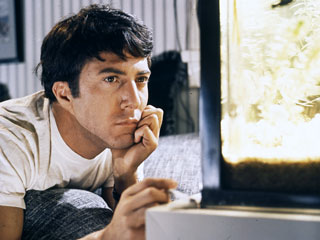
Emmy winning sound-designer (I know, right?) Yojimbo of Let’s Not Talk About Movies offers some insight below.
"40 years after the fact, The Graduate is a better film than when first released. Taken apart from the flush of the “Summer of Love” and a naïve association with “revolutionary” “stick-it-to-the-Establishment” behavior, it can now be seen for what it is: two kids in the process of becoming their parents. Elaine Robinson, the object of Ben’s ADD affection, is the product of a marriage of convenience, her Mother abandoning her dreams for domesticity, and now Ben Braddock has whisked her off in a similar moment of heat without thought. Meet the new beau, same as the old beau. Brilliantly, Nichols holds on that last shot of the two rebels as the adrenaline seeps away and the 'Now what’s' sink in. The Graduate is better—and more relevant--than ever."
That’s a reading I wasn’t going to come up with by little own self, though that “now what” look at the end always roused me. Even in the original review for The Graduate I was harping on it. But, it’s the uncertainty – of their looks, and the meanings – that adds to the specialness of the ending. I really am whimsical and I like to think a little more positively than Yojimbo there. All evidence seems to imply that the two are headed down a loveless marriage, and then I think “Who knows?” Maybe they will be the unlikely success, and no better way to try that than away from their toxic parents. It’s weird that I end up starting with the ending, though. It’s not the first thing that’s thought of when persons hear of the The Graduate – is it?

It’s weird how Anne Bancroft has become, in a de facto way, the thing that many persons associate The Graduate with. That leg covered in that stocking (which wasn’t even hers to begin with) is certainly alluring, but as strong a performance as she gives Bancroft is just one of the many supporting characters revolving around Dustin Hoffman’s Benjamin Braddock.

Doesn’t that name read like something we’d get out of a comic book, a la Archie Andrews or Jughead Jones? I’ll always think of Benjamin as Hoffman’s magnum opus (we’ll be discussing the 67 race at the end of the month for The Actor Factor) Still, if I’m to take the words of the fellow cinephiles who’ve admitted to loving the The Graduate into account, it would seem that their thoughts are not far off from mine. The Mad Hatter of the consistently intuitive The Dark of the Matinee weighs in, and his thoughts are not a far cry from Yojimbo.
"What The Graduate does best, is tap into the restlessness that seeps into our conscience when we’re unsure of our next move. From a very young age, we’re taught the road map of life: 'Go to college, get a job, get married, have kids.'The problem is, if we complete one of those steps and find ourselves unsure of what to do next, we get antsy…and prone to some very bad decision-making. That’s what drives young Benjamin in this movie, and you can tell even he isn’t certain that he’s doing the right this. He drifts from scene-to-scene with a scared expression, and doesn’t live his life so much as he navigates it.The Graduate wants to teach us that there’s nothing wrong with not knowing the answer. Many of us get to one of these milestones in life – graduation, wedding, kids – and find ourselves thinking “now what?” (For a great example of this, pay attention to the final shot of the film). The trick is to take a moment to ourselves, and think things through. This introspection is what the film wants us to remember, and it’s something young Benjamin never seems to want to do."
I like Hatter’s thoughts on the film’s introspection. I’d still claim it as one of cinema’s brilliant comedies even if it’s more of a “things done funnily” that a “funny things done” situation. In fact, if you get too introspective you might find that The Graduate is too wistful underneath its wan setting and ridiculous characters. Nichols is probably not one we would call an auteur, but consider his film against his one from just a year before – Who’s Afraid of Virginia Woolf. It’s another ostensibly ridiculous piece that has some disturbing connotations beneath. Just like Martha and George are keen on attaining diversions in their lives to ignore their obvious aches Benjamin prefers to meander from place to place instead of making a conscious effort to “do” something. After all, you can’t be inadvertently guilty of a crime? When The Graduate takes that turning point (the first of many) that has Benjamin pursuing Elaine I’m reminded of a Stephen Sondheim quote “I chose and my world was shaken, so what? The choice may have been mistaken…the choosing was not.” I think it’s the same with Benjamin. I’m still unsure if Benjamin’s choice was the “right” one, but there’s some credibility to be found in the fact that he does make a decision. Despite my general moroseness I’m not intent on approaching the situation as bleak as Yojimbo. It’s probably because Dustin Hoffman is so affable, but I’m rooting for Ben all the way. Like me, Dan leaves room for either side of the coin:
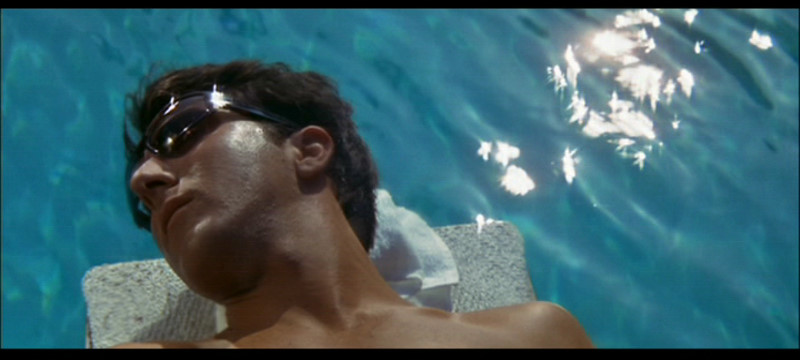
Part of the appeal of Mike Nichols The Graduate comes from when you first discover it. It has a timeless sensibility - life at a crossroads - and it beautifully encompasses the almost surreal realisation of living outside the comfort zone of childhood, of school institutions, of parents and teachers instructing you what to do. The Graduate is life when the warm, safe environment of childhood has disappeared, and adulthood has suddenly been thrust upon you. I suppose, for me, I felt like Ben Braddock when I first saw The Graduate. There’s a great shot of Dustin Hoffman floating in the pool. His father asks him what he is doing. Ben replies: “Well, I would say that I’m just drifting. Here in the pool.” “Why?” asks his father. “It’s very comfortable just to drift here,” says his son. The brilliance of Mike Nichols’ film is in how he offers that guiding light to this twenty-something conundrum. Enter Mrs Robinson.
I’ve only recently discovered Dan’s Top10Films.co.uk and it’s a blog that’s becoming a favourite. I love the way that both he and The Mad Hatter notice the drifting that’s going on with Ben. It makes me think that perhaps the jury isn’t really that split on what The Graduate is really about after all. I’m afraid I just can’t do it justice when it comes to a second review, but that doesn’t make it any less laudable. It’s still an excellent satire/comedy/social drama…or whatever the hell you want to call it.
Here it is at #9…coming closer to the top with 8 more to go. What do you remember when you think of the The Graduate?


