Tuesday, April 27, 2010

Linkin' In the Rain

It seems after watching the rain this Sunday God decided to grant me my own bouts of heavenly showers, sadly there's no Elizabeth Bennett to share it with...but there are links....and where there's a link...there's a way...kind of.
     
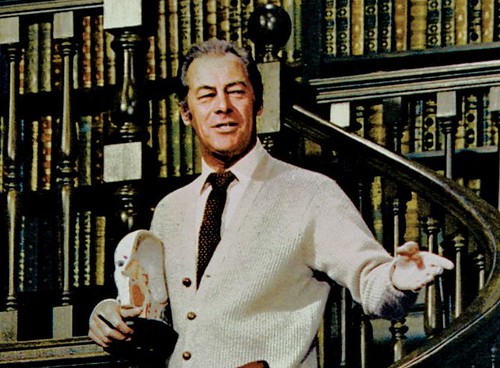
Luke, Jose and I turn our attention to 1964's Best Actor race. Rex Harrison was the eventual winner for My Fair Lady...we don't agree. Head on over to Jose's and see what our thoughts on the race were.
...and on the topic of 1964 Yojimbo takes a look at a scene from Dr. Strangelove...and speaking of Kubrick Marcy recently saw his 2001: A Space Odyssey, she didn't quite know what to make of it, though it did provide for one interesting post. What are your thoughts on Kubrick? I'm neither here nor there.
            
Talia Shire's work in Rocky is often forgotten, but a someone who actively despites Stallone and his Oscar winning flick I'm quite fond of her work. Nick Davis writes a nice piece on Shire's Oscar nominated performance in the Best Picture winner. Are you a fan?
                  

CS turns heretic on Scorsese. I disagree with 40% of his post, but it's still very interesting. Scorsese's worst films...(if there is such a thing) what would you include on it?
     
Darren ponders the implications of box office "failures". What does the phrase mean today?
        
Univarn just celebrated his 500th post, so yay for him...
            
And in case you didn't know, it's time for LAMMY's. If you don't know what they are, click here...and if you're not a LAMB...you should join.
           
...and though it's not film related, Cris celebrates some of her favourite books. What are some of yours, or you purely cinematic?
                        
Dozens more entries are available on the sidebar in case these few links don't fulfill your voracious appetites. I'm off to listen to the pit-pit-patter of the rain...

Scorsese: The Ladies’ Man?

This entry is a miscellaneous piece of sorts in commemoration of the Scorsese blog-a-thon. Bow down to the genius, or at least contribute with an entry (or head over to LAMB and check out the other entries tomorrow).
            
While looking at The Age of Innocence recently I wondered why Marty is called a man’s director. It’s a little bit of a paradox if you come to think of it. In the same way that George Cukor is called a women’s director even though he’s done films highlighting his men and women Marty is given the male monogram even though he works as effectively with his men as with his women. Sure, his films are a bit more testosterone driven, but like Streisand said – there’s always a woman. Of course he directed Alice Doesn’t Live Here Anymore to directly combat the misconceptions. The film earned Ellen Burstyn an Oscar. He hasn’t done such a female centred flick since, but the women are always necessary in his pieces. When I think of Scorsese as a pimp (I use the word loosely, of course) I always come to The Aviator. Of course, I’m just smitten with that because of the Old Hollywood allusions (and Cate/Kate the Great). Still, Howard is literally swimming a pool of women, even if he doesn’t know it himself. Yes, Cate/Kate does seem to take the forefront but from Jean to Kate to Jane to Ava it really about the women. I just pretend that the third quarter is nonexistent, of course…
But, I’ll jump ahead to the next ScorCaprio piece – The Departed. If any Scorsese film stinks of men, it’s this. Vera Farmiga is the only female who isn’t playing a whore or …a kept woman. Yet, she comes out of it looking mighty good, with an underwritten role. Her role is more than a little thankless, but she makes it all work – including that somewhat stodgy Boston accent, which I forgive her for. I’m not sure if it’s Vera’s tenacity, or Scorsese’s brilliance, but Vera’s Madolyn comes out looking better than she did after reading Monahan’s script. If we jump all the way back Good Fellas I suppose we could say the same about Lorraine Bracco, although she isn’t really the only woman on set. Her performance sneaks up on me, a little, though. I’m never expecting her to make any impact, and then she does. I don’t love the performance, but it’s still credible – and I can’t ever hate a Lorraine performance. It’s the same way with Barbara Hershey. I always think I don’t like The Last Temptation of Christ, and I every time I see it I realise I like it quite much actually. I blame it on The Natural, but I’m always apt to think Barbara Hershey is a villain. Am I the only one who thinks she’s an unlikely Mary Magdalene? I mean, she gives a courageous effort – and is quite good – but I always like to think how brilliant it would have if Marty had “discovered” Michelle for the role, before Countess Olenska. She would have been brilliant.
Speaking of The Age of Innocence, I’m always apt to call it my favourite Pfeiffer performance, even though it’s not really her film. Marty really likes his women looking good, though. Liza Minnelli is rarely as lovely as she is in New York, New York and though I’ve never been too fond of Michelle Williams, as a beauty or an actress, within her few minutes in Shutter Island I became a believer. Didn’t you wish that they’d scrapped Lehane’s whole pseudo-psychology shtick and focused on a straight drama with Leo and her? It’s as if Marty’s screwing with us, a little. I honestly become invested in the reality of that relationship, even if Michelle’s Dolores is the most wicked of Scorsese’s women. He has a thing for virtuous women, doesn’t he? Not in the usual sense, but from Madolyn, to Jenny, to Francine to Kate to Vickie how many images of the broken man being consoled by his devoted woman do we have? Sure, the hypothesis goes askew sometimes, but the similarities are interesting. But maybe that’s just him screwing with us again.
              
I can’t account for why Casino and Cape Fear, and both incidentally earned its women Oscar nominations. But I can’t account for how Juliette Lewis (admittedly good) gets nominated for every award body and Jessica Lange goes completely shafted. I’m probably one of the few that enjoyed Sharon Stone in Casino, I wasn’t gunning for her to win but it’s a nomination well deserved. Of course, Jodie Foster’s Iris doesn’t fit anywhere into the whole classification of Scorsese’s women…and I still can’t pick a favourite…I’d be stepping on someone’s toes whomever I choose…but just to go arbitrary Kate for speaking…the Countess for looks. 

Anybody Can Do Anything, Especially Scorsese: The Musical

This entry is in celebration of the Martin Scorsese blog-a-thon hosted by LAMB. If God was a man he’d be Scorsese, so ummm, contribute and head over and check out the other entries tomorrow.
              
Scorsese is really diverse – even though we don’t always realise it. He’s known for his gritty crime dramas, but he does period, he does sports, he gets religious, he goes epic and even touches on foreign drama – and of course the musical. The story behind New York/New York is legend now. Released in 1977 a year after Taxi Driver, it was a flop and poorly received by critics and audiences and led Scorsese into a depression which eventually led to the now legendary Raging Bull. It’s one of those nice comeback stories, and we all love a comeback; but New York/New York has more worth than being a catalyst for that 1980 classic. If anything New York/New York is the proof that Scorsese can do anything. The film is a tribute to the Golden Age of musical as Scorsese creates an ode to the period, it’s not perfect but it’s splendid. It’s something that you can count on Scorsese for, though. He never skimps on the technicalities.
The story is slight. A wannabe starlet and musician form a relationship and the film chronicles their experiences. I’ve been one of the many to remark that Lars Von Trier likes to f*** with you (it’s why he’s not one for me). I will admit that Scorsese tends to do it every now and then two. We spend almost half an hour in what seems like a flawed Woody Allen comedy of sorts until Marty decides to start throwing wrenches at us. Liza Minnelli and Robert DeNiro – both Oscar winners already – star as the couple and they’re good together. I’m always more than slightly miffed that Liza is not as highly regarded as she should be. New York/New York isn’t a love story, but the chemistry between she and Robert shines brighter than even the most iconic of Marty’s romances. They’re excellent together, but it’s Minnelli of course who shines brighter. It’s a pity that the film has become forgotten, it’s probably the most dramatic work I’ve seen her do (yes, even more than Cabaret). She’s never looked (or sounded) more like her mother, but she’s also never been so tender. Minnelli is the proof of how acting in musicals is more than singing, she sells her speaking part as well as her singing, and her rendition of “But the World Goes Round” is a piercing moment of the film as is her performance of the eponymous theme song.
                
But this writeup is about Marty, and it’s as it should be. Because, really, when it’s all said and done he’s really the star of this piece. You wouldn’t believe it’s a Scorsese picture if you were just an incidental fan of his. The culmination of his talents (averse to his usual fare) occurs in a ten minute musical spectacle where Liza Minnelli (opposite Broadway star Larry Kert) transport – literally – to the world of old musicals. The colour, the costumes, the lighting the editing is all fantastic and it’s a shame that this film couldn’t have at least been remembered for its astounding technical proficiencies. 1977 was a good year for film – The Turning Point, Annie Hall, Julia, Star Wars, The Goodbye Girl and more. But it’s a pity that New York/New York got lost in the shovel. It’s not one of my favourite films, and sure it’s not Scorsese’s best. But I’ll stand by it, Scorsese never made a bad film [yet] – it’s not perfect but you’ll laugh, you might cry and you’ll sure as hell want to be a musician afterwards. Trust me, you’ll be entertained.
                      
....just take a look at this ten minutes spectacle...
          
and just because, here's another song from Liza...her mother's daughter...
          
No one does it like it Marty!

Sunday, April 25, 2010

Kick Ass

The story of me and Kick-Ass is an odd one; I heard rumblings of the tongue-lashing Ebert gave to it. I didn’t read the actual piece, and I don’t care to. As much as I respect the man I’ve learned to take his words with a pinch of salt. It wasn’t deliberate, but I’ve not read a single review of Kick Ass. I know I’ve seen them around, but I didn’t – I wasn’t even sure what exactly the film was about. My state of ignorance so was high, I didn’t even realise that Nicolas Cage (someone I am not fond of) was in it. I like to think that ignorance is the perfect state of discovering a film; unhampered views do make for the easiest reviews. The story is simple, painstakingly so even.Dave Lizewski is the most average teenage male in America, it seems, and he decides to turn into a superhero. It’s an idea that is ridiculous, but not unbelievable. The film chronicles the success of his self titled alter ego Kick-Ass and the journey it takes him on. This fairly simple plot is paralleled by another fairly simple one. Nicolas Cage plays Damon Macready, a police officer wrongfully sent to jail for five years. His wife died in childbirth from an overdose, and Damon trains his daughter into some prodigious (wait for it) super girl of sorts. He is intent on taking down kingpin Frank D'Amico who he considers as the reason for his tragedy. Naturally, the two ostensible parallel plots must converge, and therein lays the crux of Kick-Ass.
            
Amid its ostensible striving for normalcy and even pedestrian monotony Matthew Vaughn is intent on making his hero as nuanced as possible. It lends a smartness to the first third of the film which is unfortunately juxtaposed with some moments of ridiculous. As Dave narrates of his painfully normal life his exacerbated sexual arousal – interestingly enough, something that’s forgotten after the first fifteen minutes – or even his initial overt clumsiness make him atypical even amidst the normalcy he clings to. Moreover, his voice-over narration, a plus to the film, don’t suggest someone shrouded by incessant normality, but this being a film such strange things are wont to happen. As narrative, Kick-Ass rests completely on the shoulders of Aaron Johnson. Obviously with all that screen time and overhead monologues his character easily emerges as the most rounded, but he does not squander his opportunity for the film to exist as some sort of perverse audition piece for him. If he is to continue as a credit to his industry, and even if amid the wave of its apparent “disappointing” box-office run Kick-Ass will exist as a solid showcase for his talents (as young as they are). Johnson creates an exceptionally authentic portrayal of teenage angst even when the script has him leaping from silly (like ogling at his teachers’ breast), to tenacious (Kick-Ass’s first legitimate triumph against the gang), to maudlin (his confession to Katie). Not that his performance doesn’t include the occasional misstep, but whatever fault Kick-Ass may harbour doesn’t fall anywhere in his realm.
Truthfully, I wouldn’t blame Nicolas Cage either. I’m rarely moved by him, and his performance as Big Daddy includes him doing good and him being gratuitously lazy. But overall, he manages to sell that fierce devotion to his daughter even if the very logic of his quest does border on ridiculous. I haven’t read the reviews, but I don’t doubt that it is in this subplot that Kick-Ass loses its audience, but isn’t film an obvious projection of fantasy? Hearing the twelve year old Chloë Moretz say cunt or blow (a definitely misguided) seductive kiss at our hero is nauseating to some extent, but on a base level it also provides for its own amount of hilarity and more importantly it’s completely believable in the realm of ridiculous that Kick-Ass aims at. It’s the sort of tug-of-war between excellent and terrible that Kick-Ass exists in at times. Like how Lyndsy Fonseca manages to seem believable as the object of desire and then immediately after seems absolutely nondescript in her role. Or how the writers feel the need to have our villain (played by Mark Strong) show some silly element of being a boor – despite all the evidence that suggests the man must be brilliant. But in the end, I think it’s the brilliance that wins out.
I can easily see how Kick-Ass could lose its audience. I’m a bit surprised that I liked it, I’m not usually one for the genre. But what makes Kick-Ass the success that it is (of course, I use the word loosely) is the large amount of heart it boasts. Sure, it’s difficult to see sometimes when Vaughn seems intent on burying in a wave of irreverent humour. But Kick-Ass the movie is not very different from Kick-Ass the character. There’s a real-life person beating underneath, but like the usual teenager it’s intent on hiding it beneath a host of silliness. But if you closer, you’ll realise its merits.
        
B-

Scene On A Sunday: Pride & Prejudice

I’ve had Joe Wright’s 2005 debut Pride & Prejudice on my mind a whole lot recently; although – truth be told – I’ve been thinking less of the actual film and more of the lovely lady it centres on, the lovely Keira Knightley. I remember when during the awards season in 2006, before I saw the film, I was a bit confused at the choice of clip that a number of shows played for Keira, but it wasn’t until seeing the film in its entirety I was able to place the deserved value on it. This is not a BBC version of Pride & Prejudice, Jane Austen’s very cadence is condensed into a perfectly little two hour piece and Wright’s choice in shooting Mr. Darcy’s first proposal is fresh and original. I like, for example, how he chooses to have it done immediately after Elizabeth learns of his role is thwarting her sister’s chance at marriage. She runs off for some solace, in the rain no less. The shot below is so picturesque. 
 
Keira is such a perfect fit for Elizabeth, it's almost ridiculous. She handles this scene so well, even before it actually begins, as she leans against the pillars she's so naturally upet, and yet never exagerrated.
 
And then of course Mr. Darcy comes to interrupt her thinking -
I said before that McFayden doesn't completely thrill me in the role, but his signs of discomfort work so well here, perhaps it's the rain...
Miss Elizabeth, I have struggled in vain and can bear it no longer...

Certainly, Darcy's first proposal is nowhere near is horrific as Mr. Collins', but I really must comment McFayden for selling some of the weirdest lines and still managing to make it sound (somewhat) romantic. I like how Keira responds with a look somewhere between aghast and confused.
Regardless of the overlying theme in her books, it's nice how Jane Austen always clings to filial love among her heroines and Keira portrays this excellently. Younger than her sister Jane, she is, but the penchant for shielding is handled so well as she rips into Darcy.
 
Of course Matthew is wise enough to realise that as bewitched as Darcy is by Elizabeth he's unwilling to lose an argument. As wrong as she is at the moment, it's nice to see Elizabeth growing...there's almost a hesitancy as if she's not too keen to denounce this man - even as she's certain that he's the cause for her sister's misfortune.

Of course, as we shall come to see, she's completely off in defending her beloved Mr. Wickham. Notice, too, how the mention of his name produces one of the rare moments of heightened life from McFayden's very dour Darcy.
I am to rejoice in the inferiority of your circumstances?
As misguided a line as it is, I can't help but cheer on the line and its excelllent delivery. All leading up to Keira's own notable rant...
Your arrogance and conceit, your selfish disdian for the feelings of others made me realise you were the last man in the world I would ever marry.
It's an excellent delivery of a passionate line, but am I alone in thinking that this would have led into a kiss, talk about sexual tension, eh?
And then of course he stalks off, and she's left there confused (and unkissed).
And damn, isn't she beautiful?
 
What is it about the rain...? And all that silent emoting? Why exactly is she considered to be a poor actress?
And then the scene closes with these lovely shots...
What kind of world do we live in when shots like these went unnoticed for their cinematography? Not even love for the Art Direction...the entire film went Oscar-less....Quelle domage.
Blame it on the rain....

Saturday, April 24, 2010

From Here to Eternity

Montgomery Clift and Deborah Kerr both appear on my list of admired thespians. It’s difficult to ignore the contributions both made to cinema during their time. Yet, I don’t think either of them is ever remembered as they ought to be. It’s more than them never being remembered by Oscar (Wood, Dietrich, Grant, Burton fall in the same boat), but whenever we think of the classics, I rarely recall them getting any mention. The two did star in a film together, although I’m probably stretching the truth to say that. From Here to Eternity is not a story where these two actors unite, but I still remember them first when I think of it. They should have each walked away with their Oscars here, but I’m getting ahead of myself.
                   
As a war film, From Here to Eternity is less concerned with the implications of the war at hand and more interested in the actions of the people. Remove the setting of Island and the time of the war and the tragedy in the film still persists because of the frivolity of man. It’s not difficult to see the similarities of all the wandering characters. Clift’s Prewitt says so sagely “Nobody ever lies about being lonely” and as Kerr’s ignored wife, Sinatra’s dissatisfied Private, Reed’s “good” call girl and Lancaster’s unhappy Sergeant wander on and off-screen their loneliness is palpable. They meander back and forth searching – reaching out – for some notable human connection. Philip Ober is ostensibly relegated to the role of stock villain. Anyone preventing the amicable Deborah Kerr from happiness couldn’t be too good. Lancaster has never impressed me as a thespian and the relationship forged between he and Kerr always makes me wonder at times. Kerr is not as calculating to play Karen as cold as she could (think, Kristin Scott Thomas’ Sylvia McCordle) but perhaps, that’s the very reason I do like her performance. She’s acts well within in her means, even if her range is not as expansive as I’d like. I’m never sure why Lancaster is regarded so well in this film, though admittedly he plays his role well. He’s never had a wide range, and perhaps Sgt. Milton is tailor made for him. Doubtlessly, though, I’m prejudiced.
On the topic of range, Clift’s Prewitt and his tragic outcomes seem to rote for Clift, yet I do regard this performance as one of cinema’s greatest. I know Donna Reed isn’t as wholly loved in her performance as the affable call girl, but I’m rarely moved to doubt her sincerity even as the film plays up to the stereotype of the prostitute with a heart-of-gold. Sinatra, though, is the one who confuses me the most. I may be alone here, but his work as Private Maggio impresses and befuddles me – sometimes simultaneously. He can go from being excellent, to being pedestrian in a matter of second. But after the rumour that the role was written for Eli Wallach (forgotten star of the era) I always think just how lucky Sinatra was to get his hands on the role.
From Here to Eternity is remembered most for the shot above and not as much for the performances. I often wonder if my general dissatisfaction with William Holden and Audrey Hepburn has to do with some incidental projection of the Academy's preference of the two over Clift and Kerr. I doubt, that would be too weird. From Here to Eternity, though, represents a fine example of good film making. It's a classic, rightfully so, and features an excellent cast of celebrated thespians - some more than others. It appears as #38 on my list of favourite films.
Related Posts Plugin for WordPress, Blogger...